UNITED STATES
SECURITIES AND EXCHANGE COMMISSION
WASHINGTON, D.C. 20549
INFORMATION
Proxy Statement Pursuant to Section 14(a) of
the Securities Exchange Act of 1934
(Amendment No. )
Filed by the Registrant ☒
Filed by a party other than the Registrant ☐
Check the appropriate box:
☒ Preliminary Proxy Statement
☐ Confidential, for Use of the Commission Only (as permitted by Rule 14a-6(e)(2))
☐ Definitive Proxy Statement
☐ Definitive Additional Materials
☐ Soliciting Material Under Rule 14a-12
(Name of Registrant as Specified In Its Charter)
(Name of Person(s) Filing Proxy Statement, if other than the Registrant)
Payment of Filing Fee (Check all boxes that apply):
☒ No fee required.
☐ Fee paid previously with preliminary materials.
☐ Fee computed on table in exhibit required by Item 25(b) per Exchange Act Rules 14a-6(i)(1) and 0-11
PRELIMINARY PROXY STATEMENT DATED NOVEMBER 24, 2026 - SUBJECT TO COMPLETION
254 West 31st Street, 11th Floor
New York, New York 10001
, 2026
To the Stockholders of XWELL, Inc.:
You are cordially invited to attend the annual meeting (the “Annual Meeting”) of the stockholders of XWELL, Inc. (the “Company”), to be conducted in a virtual format only via live audio webcast at 10:00 a.m. Eastern Time, on Tuesday, December 30, 2026.
In order to facilitate stockholder attendance and participation by enabling stockholders to participate from any location at no cost, this Annual Meeting will be conducted in a virtual format only. Stockholders will not be able to attend the Annual Meeting in person; however, stockholders of record will be able to participate, vote electronically and submit questions during the live webcast of the Annual Meeting by visiting www.virtualshareholdermeeting.com/XWEL2026 and entering the 16-digit control number found on the enclosed proxy card or voting form. If you encounter any difficulties accessing the virtual Annual Meeting, please call the technical support number available on the virtual meeting page on the morning of the Annual Meeting.
Your vote is very important, regardless of the number of shares of our voting securities that you own. To vote your shares, you may use the enclosed proxy card, vote by telephone or over the Internet, or attend the meeting and vote in person. If your shares are held in the name of a broker, trust, bank or other nominee, and you receive these materials through your broker or through another intermediary, please complete and return the materials in accordance with the instructions provided to you by such broker or other intermediary or contact your broker directly in order to obtain a proxy issued to you by your nominee holder to attend the Annual Meeting and vote in person. Failure to do so may result in your shares not being eligible to be voted by proxy at the Annual Meeting.
On behalf of the Board of Directors, I urge you to submit your proxy as soon as possible, even if you currently plan to attend the Annual Meeting virtually.
Thank you for your support of our Company. I look forward to seeing you at the virtual Annual Meeting.
| By Order of the Board of Directors, |
| Ezra T. Ernst |
| President and Chief Executive Officer |
, 2026
254 West 31st Street, 11th Floor
New York, New York 10001
, 2026
NOTICE OF 2026 ANNUAL MEETING OF STOCKHOLDERS
Notice is hereby given to the holders of the shares of common stock, par value $0.01 per share (the “Common Stock”) of XWELL, Inc. (the “Company”) of the Company’s 2026 annual meeting of stockholders (including any adjournment, postponement or rescheduling thereof, the “Annual Meeting”).
| DATE: | Tuesday, December 30, 2026 |
| TIME: | 10:00 a.m. Eastern Time |
| ACCESS: | The Annual Meeting will be held in a virtual meeting format only, via live audio webcast on the Internet. Stockholders will not be able to attend the Annual Meeting in person. Stockholders will be able to virtually attend the Annual Meeting by visiting www.virtualshareholdermeeting.com/XWEL2026 and entering the control number included in your proxy card. |
PURPOSE: At the Annual Meeting, we will ask stockholders to consider the following proposals:
| 1. | To elect Bruce T. Bernstein, Robert Weinstein, Gaëlle Wizenberg, Michael Lebowitz, and Gerard Reid to our Board of Directors (the “Board”), each to serve until the 2027 annual meeting of stockholders or until his or her respective successor is duly elected and qualified (the “Director Election Proposal”); |
| 2. |
To ratify the selection of CBIZ CPAs P.C. as our independent registered public accounting firm for the fiscal year ending December 31, 2026 (the “Auditor Ratification Proposal”); |
| 3. | To approve an amendment (the “Reverse Stock Split Amendment”), substantially in the form attached hereto as Annex A, to the Company’s Certificate of Incorporation to effect, at the discretion of the Board but prior to the one-year anniversary of the reverse stock split (the “Reverse Stock Split”) approval by the Company’s stockholders at the Annual Meeting, the Reverse Stock Split at a ratio in the range of 1-for-2 to 1-for-25, with such ratio to be determined by the Board in its discretion and as disclosed in a public announcement (the “Reverse Stock Split Proposal”); |
| 4. | To approve the adjournment of the Annual Meeting to a later date or dates, if necessary or appropriate, to permit further solicitation and vote of proxies in the event that there are insufficient votes for, or otherwise in connection with, the approval of any one or more of the foregoing proposals (the “Adjournment Proposal”); and |
| 5. | To transact such other business as may properly come before the Annual Meeting or any adjournments or postponements thereof. |
Stockholders may also consider and act upon such other matters as may properly come before the Annual Meeting.
The foregoing items of business are more fully described in the Proxy Statement accompanying this Notice of Annual Meeting of Stockholders. Your vote is being solicited on behalf of the Board. The Board unanimously recommends stockholders vote “FOR” the Director Election Proposal, the Auditor Ratification Proposal, the Reverse Stock Split Proposal, and the Adjournment Proposal on the enclosed Proxy Card. The Proxy Statement and the Proxy Card are first being made available to stockholders on or about .
If you are a beneficial owner of shares and you hold your shares in “street name” with a broker, bank or other nominee, only that entity can vote your shares and only upon its receipt of your specific instructions. Accordingly, please contact the person responsible for your account at such entity and instruct that person to vote on your behalf “FOR” the Director Election Proposal, the Auditor Ratification Proposal, the Reverse Stock Split Proposal, and the Adjournment Proposal. You should also complete, sign, date and promptly return the voting instruction form that your broker, bank or other nominee sends you (or, if applicable, vote by following the instructions supplied to you by your broker, bank or other nominee, including voting via the Internet or by telephone). Please do this for each account you maintain to ensure that all of your shares are voted.
Only stockholders of record at the close of business on November 9, 2026 (the “Record Date”), are entitled to notice of the Annual Meeting and to vote at the Annual Meeting or any adjournment, postponement or rescheduling thereof. At any adjourned, postponed or rescheduled meeting, action with respect to matters specified in this Notice of Annual Meeting of Stockholders may be taken without further notice to stockholders, unless required by law or the Company’s Third Amended and Restated Bylaws.
A list of stockholders of record will be available starting on December 20, 2026, at least ten days prior to the Annual Meeting, at our headquarters, 254 West 31st Street, 11th Floor, New York, New York 10001. If you would like to view the stockholder list, please contact the Company’s Corporate Secretary at (212) 750-9595 to schedule an appointment or for alternative arrangements to the extent office access is impracticable. In addition, a list of stockholders of record will be available during the Annual Meeting on the virtual meeting site for inspection by stockholders of record for any legally valid purpose related to the Annual Meeting.
Stockholders of record may vote (i) by completing, signing, dating and promptly returning the enclosed Proxy Card in the postage-paid envelope provided, (ii) via the Internet by following the instructions on the Proxy Card or (iii) by calling the toll-free number found on the enclosed Proxy Card. Stockholders of record may also vote at the Annual Meeting. Instructions regarding these methods of voting are contained in the Proxy Statement and on the Proxy Card. Please vote by whichever method is most convenient for you to ensure that your shares are represented at the Annual Meeting.
IT IS IMPORTANT THAT YOUR SHARES ARE REPRESENTED AT THE ANNUAL MEETING, REGARDLESS OF WHETHER YOU PLAN TO ATTEND VIRTUALLY. ACCORDINGLY, WE ENCOURAGE YOU, AS PROMPTLY AS POSSIBLE, TO COMPLETE, SIGN, DATE AND PROMPTLY RETURN THE ENCLOSED PROXY CARD IN ORDER TO ENSURE YOUR REPRESENTATION AT THE ANNUAL MEETING. GIVING YOUR PROXY WILL NOT AFFECT YOUR RIGHT TO VOTE VIRTUALLY IF YOU ATTEND THE ANNUAL MEETING, BUT WILL HELP ASSURE A QUORUM. ATTENDANCE AT THE ANNUAL MEETING IS LIMITED TO STOCKHOLDERS, THEIR PROXIES AND INVITED GUESTS OF THE COMPANY.
| By Order of the Board of Directors, |
| Ezra T. Ernst |
| President and Chief Executive Officer |
, 2026
IMPORTANT NOTICE REGARDING THE AVAILABILITY OF PROXY MATERIALS
FOR THE STOCKHOLDER MEETING
TO BE HELD VIRTUALLY ON DECEMBER 30, 2026
The Notice of Annual Meeting of Stockholders, the accompanying Proxy Statement and our Annual Report on Form 10-K for the year ended December 31, 2025, as amended (the “2025 Annual Report”) are available free of charge for viewing, printing and downloading at www.virtualshareholdermeeting.com/XWEL2026. Information on this website, other than the Proxy Statement, is not part of the Proxy Statement.
Additionally, you can find a copy of the Proxy Statement and our 2025 Annual Report on the U.S. Securities and Exchange Commission’s website at www.sec.gov, or in the “SEC Filings” section of the “Investors” section of our website at www.xwell.com. Information on these websites, other than the Proxy Statement, is not part of the Proxy Statement. You may also obtain a printed copy of our 2025 Annual Report, including our financial statements, free of charge, from us by sending a written request to: XWELL, Inc., 254 West 31st Street, 11th Floor, New York, New York 10001, Attention: Corporate Secretary. Exhibits will be provided upon written request and payment of an appropriate processing fee.
Please complete, sign, date and promptly return the enclosed Proxy Card in the postage-paid envelope provided or vote your shares promptly via the Internet or by telephone by following the instructions on the Proxy Card, so that you may be represented at the Annual Meeting. Instructions are in the Proxy Statement, on the Proxy Card or, if your shares are held in “street name,” on the voting instruction form provided by your broker, bank, or other nominee.
The accompanying Proxy Statement provides a detailed description of the business to be conducted at the Annual Meeting. We urge you to read the accompanying Proxy Statement carefully and in its entirety.
TABLE OF CONTENTS
XWELL, INC.
254 West 31st Street, 11th Floor
New York, New York 10001
PROXY STATEMENT
ANNUAL MEETING OF STOCKHOLDERS
TO BE HELD ON DECEMBER 30, 2026
This Proxy Statement, along with the accompanying Notice of the Annual Meeting of Stockholders, contains information about the 2026 annual meeting of stockholders (including any adjournment, postponement or rescheduling thereof, the “Annual Meeting”) of XWELL, Inc. (“XWELL,” the “Company,” “we,” or “us”).
The Annual Meeting will be held at 10:00 a.m. Eastern Time on Tuesday, December 30, 2026. The Annual Meeting will be held in a virtual meeting format only, via live audio webcast on the Internet. Stockholders will not be able to attend the Annual Meeting in person. Stockholders will be able to attend the Annual Meeting by visiting www.virtualshareholdermeeting.com/XWEL2026 and entering the control number included in your proxy card.
Only stockholders of record of our common stock, par value $0.01 per share (the “Common Stock”), at the close of business on November 9, 2026 (the “Record Date”), are entitled to notice of the Annual Meeting and to vote at the Annual Meeting. The Proxy Statement and the Proxy Card are first being made available to stockholders on or about , 2026.
Your vote is being solicited on behalf of the Company’s board of directors (the “Board” or the “Board of Directors”). At the Annual Meeting, we will ask stockholders to consider the following proposals:
| 1. | To elect Bruce T. Bernstein, Robert Weinstein, Gaëlle Wizenberg, Michael Lebowitz and Gerard Reid to our Board of Directors (the “Board”), each to serve until the 2027 annual meeting of stockholders or until his or her respective successor is duly elected and qualified (the “Director Election Proposal”); |
| 2. | To ratify the selection of CBIZ CPAs P.C. as our independent registered public accounting firm for the fiscal year ending December 31, 2026 (the “Auditor Ratification Proposal”); |
| 3. | To approve an amendment (the “Reverse Stock Split Amendment”), substantially in the form attached hereto as Annex A, to the Certificate of Incorporation to effect, at the discretion of the Board but prior to the one-year anniversary of the reverse stock split (the “Reverse Stock Split”) approval by the Company’s stockholders at the Annual Meeting, the Reverse Stock Split at a ratio in the range of 1-for-2 to 1-for-25, with such ratio to be determined by the Board in its discretion and as disclosed in a public announcement (the “Reverse Stock Split Proposal”); |
| 4. | To approve the adjournment of the Annual Meeting to a later date or dates, if necessary or appropriate, to permit further solicitation and vote of proxies in the event that there are insufficient votes for, or otherwise in connection with, the approval of any one or more of the foregoing proposals (the “Adjournment Proposal”); and |
| 5. | To transact such other business as may properly come before the Annual Meeting or any adjournments or postponements thereof. |
Stockholders may also consider and act upon such other matters as may properly come before the Annual Meeting.
YOUR VOTE IS IMPORTANT. WE URGE YOU TO COMPLETE, SIGN, DATE AND PROMPTLY RETURN THE ENCLOSED PROXY CARD. FOR ADDITIONAL INSTRUCTIONS, PLEASE REFER TO THE ENCLOSED PROXY CARD.
IMPORTANT INFORMATION ABOUT THE ANNUAL MEETING AND VOTING
Why Did I Receive These Proxy Materials?
You are receiving this Proxy Statement as a stockholder of the Company as of the Record Date for purposes of determining the stockholders entitled to receive notice of and vote at the Annual Meeting and in connection with the solicitation by the Board of proxies to be voted at the Annual Meeting. As a stockholder of the Company as of the Record Date, you are entitled to vote at the Annual Meeting on the following proposals:
| 1. | To elect Bruce T. Bernstein, Robert Weinstein, Gaëlle Wizenberg, Michael Lebowitz and Gerard Reid to our Board, each to serve until the 2027 annual meeting of stockholders or until his or her respective successor is duly elected and qualified (the “Director Election Proposal”); |
| 2. | To ratify the selection of CBIZ CPAs P.C. as our independent registered public accounting firm for the fiscal year ending December 31, 2026 (the “Auditor Ratification Proposal”); |
| 3. |
To approve the Reverse Stock Split Amendment (as defined herein), substantially in the form attached hereto as Annex A, to the Company’s Certificate of Incorporation to effect, at the discretion of the Board but prior to the one-year anniversary of the Reverse Stock Split (as defined herein) approval by the Company’s stockholders at the Annual Meeting, the Reverse Stock Split at a ratio in the range of 1-for-2 to 1-for-25, with such ratio to be determined by the Board in its discretion and as disclosed in a public announcement (the “Reverse Stock Split Proposal”);
|
| 4. | To approve the adjournment of the Annual Meeting to a later date or dates, if necessary or appropriate, to permit further solicitation and vote of proxies in the event that there are insufficient votes for, or otherwise in connection with, the approval of any one or more of the foregoing proposals (the “Adjournment Proposal”); and |
| 5. | To transact such other business as may properly come before the Annual Meeting or any adjournments or postponements thereof. |
Stockholders may also consider and act upon such other matters as may properly come before the Annual Meeting. We are not aware of any such other matters that may properly come before the Annual Meeting at the present time. If any other matters are properly brought before the Annual Meeting, the persons named in the enclosed Proxy Card or voting instruction form will vote the shares they represent in accordance with their best judgment and in the manner they believe to be in the best interest of the Company to the extent permitted by Rule 14a-4(c) of the Securities Exchange Act of 1934, as amended, and the rules and regulations promulgated thereunder (the “Exchange Act”).
| 1 |
How Does the Board Recommend That I Vote on the Proposals?
The Board unanimously recommends that you vote “FOR” each of the Director Election Proposal, the Auditor Ratification Proposal, the Reverse Stock Split Proposal, and the Adjournment Proposal.
Who Can Vote?
Only stockholders who owned shares of our Common Stock at the close of business on November 9, 2026 (the “Record Date”), are entitled to vote at the Annual Meeting. On the Record Date, there were 10,620,883 shares of Common Stock issued and outstanding and entitled to vote. As of the Record Date, the Common Stock is the only class of voting stock.
Is My Vote Important?
Yes, your vote is very important. We urge you to vote, regardless of the number of shares you own or whether you are able to attend the Annual Meeting virtually. Please complete, sign, date and promptly return the enclosed Proxy Card in the postage-paid envelope provided or vote over the Internet or by telephone by following the instructions on the enclosed Proxy Card, even if you plan to attend the Annual Meeting virtually.
Who Is Soliciting My Vote?
The Board, on behalf of the Company, is soliciting your proxy to vote your shares of our Common Stock on all matters scheduled to come before the Annual Meeting, whether or not you attend the Annual Meeting virtually. By submitting your proxy and voting instructions via the Internet, by telephone or by completing, signing, dating and promptly returning the enclosed Proxy Card, you are authorizing the persons named as proxies to vote your shares of Common Stock at the Annual Meeting as you have instructed. Proxies will be solicited on behalf of the Board by the Company’s directors and certain executive officers of the Company.
Additionally, the Company has retained Alliance Advisors, LLC (“Alliance”), a proxy solicitation firm, which may solicit proxies on the Board’s behalf. You may also be solicited by press releases issued by us, postings on our website or other websites or otherwise. Unless expressly indicated otherwise, information contained on our website is not part of this Proxy Statement. In addition, none of the information on the other websites, if any, listed in this Proxy Statement is part of this Proxy Statement. Such website addresses are intended to be inactive textual references only.
Can I Access the Proxy Materials on the Internet?
Yes. The Company’s Proxy Statement and the Annual Report on Form 10-K for the year ended December 31, 2025, as amended, (the “2025 Annual Report”) are available free of charge at www.virtualshareholdermeeting.com/XWEL2026. You may also obtain these materials at the U.S. Securities and Exchange Commission (the “SEC”) website at www.sec.gov.
How Can Stockholders Attend the Annual Meeting? Am I Entitled to Attend the Annual Meeting in Person? Why Are You Holding a Virtual Annual Meeting?
This Annual Meeting will be held in a virtual meeting format only, and it is open to all of our stockholders. We are excited to embrace the latest technology to provide ease of access, real-time communication and cost savings for our stockholders and our Company. Hosting a virtual meeting provides easy access for our stockholders and facilitates participation because stockholders can participate from any location around the world.
| 2 |
What Happens if There Are Technical Difficulties during the Annual Meeting?
There will be technicians ready to assist you with any technical difficulties you may have accessing the Annual Meeting live audio webcast. Please be sure to check in 15 minutes prior to the start of the Annual Meeting, so that any technical difficulties may be addressed before the Annual Meeting live audio webcast begins.
What are the Voting Rights of the Stockholders?
Our Common Stock is the only class of voting stock entitled to vote at the Annual Meeting. Each holder of Common Stock is entitled to one vote per share of Common Stock on all matters to be acted upon at the Annual Meeting.
How Do I Vote?
Whether or not you plan to attend the Annual Meeting, we urge you to vote by proxy. All shares represented by valid proxies that we receive through this solicitation, and that are not revoked, will be voted in accordance with your instructions. If you properly submit a proxy without giving specific voting instructions, your shares will be voted in accordance with the Board’s recommendations, as described below under “How Will My Proxy Be Voted?” Voting by proxy will not affect your right to attend the Annual Meeting virtually.
Stockholder of Record: Shares Registered in Your Name
If, as of the Record Date, your shares are registered directly in your name, you may vote your shares in one of the following ways:
| ● | Voting Via the Internet: You may vote via the Internet by following the instructions on the Proxy Card. Go to www.proxyvote.com and have your Proxy Card available. The Internet voting facilities will close at 11:59 p.m. Eastern Time on December 29, 2026. |
| ● | By Mail: If you received a Proxy Card by mail, you can vote by completing, signing, dating and promptly returning the enclosed Proxy Card in the postage-paid envelope provided. A completed Proxy Card returned by mail must be received at the address stated on the Proxy Card before December 29, 2026. If you sign the enclosed Proxy Card but do not specify how you want your shares voted, they will be voted in accordance with the Board’s recommendations as described below under “How Will My Proxy Be Voted?” |
| 3 |
| ● | By Telephone: You may vote by telephone by calling 1-800-690-6903 and following the instructions on the Proxy Card. The telephone voting facilities will close at 11:59 p.m. Eastern Time on December 29, 2026. |
| ● | Virtually at the Annual Meeting: You will also be able to vote your shares electronically by participating in the virtual Annual Meeting. To participate in the virtual Annual Meeting, you will need the control number included on your proxy card or on the instructions that accompanied your proxy materials. |
If you are a stockholder of record, your virtual control number will be on your Notice of Internet Availability of Proxy Materials or Proxy Card. Even if you plan to attend the Annual Meeting virtually, we recommend that you also submit your proxy via the Internet, by telephone or by mail so that your vote will be counted if you later decide not to attend the Annual Meeting. Internet and telephone voting facilities for record stockholders will be available 24 hours a day and will close at 11:59 p.m. Eastern Time on December 29, 2026.
Beneficial Owner: Shares Registered in the Name of Broker, Bank or Other Nominee
If you hold your shares in “street name,” your bank, broker or other nominee should provide to you a request for voting instructions along with the Company’s proxy solicitation materials. By completing the voting instruction card, you may direct your nominee how to vote your shares. If you partially complete the voting instruction but fail to complete one or more of the voting instructions, then your nominee may be unable to vote your shares with respect to the proposal as to which you provided no voting instructions. See “What is a broker non-vote? What is discretionary voting?” below. Alternatively, if you want to vote your shares during the Annual Meeting, you must contact your nominee directly in order to obtain a proxy issued to you by your nominee holder. Note that a broker letter that identifies you as a stockholder is not the same as a nominee-issued proxy.
If you hold your shares beneficially through a broker, bank or other nominee, you may attend and vote your shares during the Annual Meeting by visiting www.virtualshareholdermeeting.com/XWEL2026 and entering the control number included on your voting instruction form or other instructions provided by your broker, bank or other nominee.
How Will My Proxy Be Voted?
Shares represented by properly executed Proxy Cards will be voted in accordance with the directions indicated thereon. If you sign the Proxy Card but do not make any specific choices, your proxy will vote your shares “FOR” each of the Director Election Proposal, the Auditor Ratification Proposal, the Reverse Stock Split Proposal, and the Adjournment Proposal.
Why are we Electing to Effect the Reverse Stock Split and How Will the Reverse Stock Split be Effected?
As previously disclosed on the Current Report on Form 8-K filed with the SEC on October 20, 2026, on October 7, 2026, the Company received a letter (the “Notice”) from the Nasdaq Listing Qualifications staff (the “Staff”) of The Nasdaq Stock Market LLC (“Nasdaq”) notifying the Company that, based upon the closing bid price of the Company’s common stock for the 30 consecutive business days from August 25, 2026 through October 6, 2026, the Company is not in compliance with the minimum bid price requirement for continued listing on The Nasdaq Capital Market as set forth in Nasdaq Listing Rule 5550(a)(2) (the “Minimum Bid Price Requirement”). Nasdaq Listing Rule 5550(a)(2) requires listed securities to maintain a minimum bid price of $1.00 per share.
Under Nasdaq Listing Rule 5810(c)(3)(A), the Company has been provided a compliance period of 180 calendar days, or until April 5, 2027, to regain compliance with the Minimum Bid Price Requirement. To regain compliance, the closing bid price of the Company’s common stock must be at least $1.00 per share for a minimum of ten consecutive business days during the compliance period, unless the Staff exercises its discretion to require a longer period. If the Company chooses to implement a reverse stock split to regain compliance, it must complete the reverse stock split no later than ten business days prior to April 5, 2027.
To maintain our listing on Nasdaq and compliance with the continued listing requirements of Nasdaq, our Board has unanimously adopted a resolution declaring advisable, and recommending to our stockholders for their approval, the Reverse Stock Split Amendment authorizing the Reverse Stock Split, and granting the Board the discretion to file the Reverse Stock Split Amendment with the Secretary of State of the State of Delaware effecting the Reverse Stock Split prior to the one-year anniversary of the date on which the Reverse Stock Split is approved by the Company’s stockholders at the Annual Meeting or to abandon the Reverse Stock Split altogether. The form of the proposed Reverse Stock Split Amendment is attached to this Proxy Statement as Annex A.
The Reverse Stock Split Amendment will effect the Reverse Stock Split by reducing the number of outstanding shares of Common Stock as compared to the number of outstanding shares immediately prior to the effectiveness of the Reverse Stock Split, but will not increase the par value of Common Stock, and will not change the number of authorized shares of our capital stock. Stockholders are urged to carefully read Annex A. If implemented, the number of shares of our Common Stock owned by each of our stockholders will be reduced by the same proportion as the reduction in the total number of shares of our Common Stock outstanding, so that the percentage of our outstanding Common Stock owned by each of our stockholders will remain approximately the same, except to the extent that the Reverse Stock Split could result in some or all of our stockholders receiving one share of Common Stock in lieu of a fractional share. See also “- Reasons for the Reverse Stock Split Amendment” in Proposal 3 - The Reverse Stock Split Proposal on page 11.
What Is the Difference Between a Stockholder of Record and a “Street Name” Holder?
If, as of the Record Date, your shares are registered directly in your name with our stock transfer agent, Equiniti Trust Company, LLC, you are considered the stockholder of record with respect to those shares.
If, as of the Record Date, your shares are held with a broker, bank or other nominee, then the organization holding your account is considered the record holder of those shares. You are considered the beneficial owner of these shares, and your shares are held in “street name.” As a beneficial owner, you have the right to direct your broker, bank or other nominee on how to vote the shares in your account. You are also invited to attend the Annual Meeting. However, because you are not the stockholder of record, you may not vote your shares at the Annual Meeting unless you request and obtain a valid legal proxy from your broker, bank or other nominee. If your shares are held in “street name” (that is, held by a broker, bank or other nominee), you will receive voting instructions from your broker, bank or other nominee. Please follow the instructions from your broker, bank or other nominee included with these proxy materials, or contact your broker, bank or other nominee to request a legal proxy. If you hold your shares in “street name,” please instruct your broker, bank or other nominee how to vote your shares using the voting instruction form provided by your broker, bank or other nominee so that your vote can be counted. The voting instruction form provided by your broker, bank or other nominee may also include information about how to submit your voting instructions over the Internet.
| 4 |
What is a Broker Non-Vote? What is Discretionary Voting?
A broker non-vote occurs when the broker holding shares for a beneficial owner has not received voting instructions from the beneficial owner and does not have discretionary authority to vote the shares. Under rules applicable to securities brokerage firms, a broker who holds your shares in “street name” does not have the authority to vote those shares on any “non-routine” proposal, except in accordance with voting instructions received from you. On the other hand, your broker may vote your shares on certain “routine matters,” if the broker has transmitted proxy-soliciting materials to you, as the beneficial owner of the shares, but has not received voting instructions from you on such proposals.
If you do not provide voting instructions to your broker, then your shares will not be voted at the Annual Meeting on any proposal with respect to which your broker does not have discretionary authority except as to “routine matters.” At the Annual Meeting, only the Auditor Ratification Proposal, the Reverse Stock Split Proposal, and the Adjournment Proposal will be considered “routine matters” and therefore, if you do not provide voting instructions to your broker regarding the Auditor Ratification Proposal, the Reverse Stock Split Proposal, and the Adjournment Proposal, your broker will be permitted to exercise discretionary voting authority to vote your shares on such proposals. The Director Election Proposal is not considered a “routine matter,” and accordingly, in the absence of specific instructions from you, your broker does not have discretionary authority to vote your shares with respect to such proposal. If you are a beneficial owner, we encourage you to instruct your broker, bank or other nominee how to vote your shares using the voting instruction form provided by your broker, bank or other nominee so that your vote can be counted.
May I Change or Revoke My Proxy?
If you are the stockholder of record, you may change your proxy instructions or revoke your proxy at any time before your proxy is voted at the Annual Meeting. You may change or revoke your proxy in any one of the following ways:
| ● | Returning a later-dated proxy (i) by completing, signing, dating and promptly returning the enclosed Proxy Card, (ii) via the Internet by following the instructions on the enclosed Proxy Card or (iii) by calling the toll-free number found on the enclosed Proxy Card (the latest dated proxy is the only one that counts), in each case, the date and time specified above under “How Do I Vote?”; |
| ● | by notifying our Corporate Secretary in writing before the Annual Meeting that you have revoked your proxy; or |
| ● | by attending the Annual Meeting virtually and voting at the Annual Meeting (attending the Annual Meeting virtually will not in and of itself revoke a previously submitted proxy). |
Your most current vote, whether via the Internet, by telephone or by completing, signing, dating and promptly returning the enclosed Proxy Card is the one that will be counted.
What if I Receive More Than One Notice of Annual Meeting of Stockholders or Proxy Card?
We may conduct multiple mailings before the Annual Meeting to ensure stockholders have our latest proxy information and materials to vote. We may send you a new Proxy Card or voting instruction form with each mailing, regardless of whether you have previously voted. Also, many of our stockholders hold their shares in more than one account and may receive separate proxy cards or voting instructions forms for each of those accounts. If you receive more than one Proxy Card, your shares are registered in more than one name or are registered in different accounts. Please vote in the manner described above under “How Do I Vote?” for each account to ensure that all of your shares are voted.
ONLY THE LATEST DATED PROXY YOU SUBMIT WILL BE COUNTED.
What Constitutes a Quorum for the Annual Meeting?
The presence virtually or by proxy of the holders of shares of stock having one-third (33.33%) of the votes which could be cast by the holders of all outstanding shares of stock entitled to vote at the Annual Meeting shall be necessary and sufficient to constitute a quorum. If, however, such quorum is not present or represented at any meeting of the stockholders, then either (i) the chairperson of the Annual Meeting, or (ii) the stockholders entitled to vote at the meeting, present virtually or represented by proxy, shall have the power to adjourn the Annual Meeting from time to time, in the manner provided in the Third Amended and Restated Bylaws (the “Bylaws”), until a quorum is present or represented.
| 5 |
What Vote is Required to Approve Each Proposal and How are Votes Counted?
| Proposal 1 - Director Election Proposal |
Directors shall be elected by a plurality of the voting power of the shares present in person or represented by proxy at the Annual Meeting and entitled to vote on the election of directors. That means that the five nominees for director who receive the most votes will be elected.
Stockholders may vote “FOR” each nominee or “WITHHOLD” their vote from each nominee.
Withheld votes will have no effect on the outcome of the election of directors.
Because the Director Election Proposal is not considered a “routine matter,” your bank, broker, trustee or other nominee, as the case may be, will not be able to vote your shares without your instruction with respect to the Director Election Proposal. As a result, the failure to instruct your bank, broker, trustee or other nominee as to how to vote on the Director Election Proposal will result in a broker non-vote, which will have no effect on the results of this vote. |
| Proposal 2 - Auditor Ratification Proposal |
The affirmative vote of a majority of the votes cast by the stockholders present in person or represented by proxy, voting affirmatively or negatively at the Annual Meeting and entitled to vote on the Auditor Ratification Proposal is required to approve the Auditor Ratification Proposal.
“ABSTAIN” votes will have no effect on the Auditor Ratification Proposal.
Because the Auditor Ratification Proposal is a “routine matter,” broker non-votes are not expected to occur with respect to the Auditor Ratification Proposal because your broker has discretionary authority to vote your shares with respect to such proposal. Failure by your broker to exercise its discretionary authority to vote your shares on the Auditor Ratification Proposal will have no effect thereon. |
| Proposal 3 – Reverse Stock Split Proposal | The affirmative vote of a majority of the votes cast by the stockholders present in person or represented by proxy, voting affirmatively or negatively at the Annual Meeting and entitled to vote on the Reverse Stock Split Proposal is required to approve the Reverse Stock Split Proposal.
“ABSTAIN” votes will have no effect on the Reverse Stock Proposal.
Because the Reverse Stock Split Proposal is a “routine matter,” broker non-votes are not expected to occur with respect to the Reverse Stock Split Proposal because your broker has discretionary authority to vote your shares with respect to such proposal. Failure by your broker to exercise its discretionary authority to vote your shares on the Reverse Stock Split Proposal will have no effect thereon. |
| Proposal 4 - Adjournment Proposal |
The affirmative vote of a majority of the votes cast by the stockholders present in person or represented by proxy, voting affirmatively or negatively at the Annual Meeting and entitled to vote on the Adjournment Proposal is required to approve the Adjournment Proposal.
“ABSTAIN” votes will have no effect the Adjournment Proposal.
Because the Adjournment Proposal is a “routine matter,” broker non-votes are not expected to occur with respect to the Adjournment Proposal because your broker has discretionary authority to vote your shares with respect to such proposal. Failure by your broker to exercise its discretionary authority to vote your shares on the Adjournment Proposal will have no effect thereon. |
Who Counts the Votes?
All votes will be tabulated by Broadridge Financial Solutions, the inspector of election appointed for the Annual Meeting. Each proposal will be tabulated separately.
| 6 |
Do I Have Any Dissenters’ Or Appraisal Rights With Respect to Any of the Matters to be Voted on at the Annual Meeting?
No. None of our stockholders has any dissenters’ or appraisal rights with respect to the matters to be voted on at the Annual Meeting.
Where Can I Find the Voting Results of the Annual Meeting?
The final voting results will be reported on Form 8-K, which will be filed with the SEC within four business days after the Annual Meeting. If our final voting results are not available within four business days after the Annual Meeting, we will file a Form 8-K reporting the preliminary voting results and subsequently file the final voting results in an amendment to the Form 8-K within four business days after the final voting results are known to us.
What Are the Costs of Soliciting these Proxies?
The costs and expenses of the Board’s solicitation of proxies, including the preparation, printing and mailing of this Proxy Statement, the Proxy Card, the Notice of the Annual Meeting of Stockholders and any additional information furnished to stockholders by us, will be borne by us. Solicitation of proxies may be in person, by telephone, electronic mail or personal solicitation by our directors, officers or staff members. Other than the persons described in this Proxy Statement, no general class of our employees will be employed to solicit stockholders in connection with this proxy solicitation. However, in the course of their regular duties, our employees, officers and directors may be asked to perform clerical or ministerial tasks in furtherance of this solicitation. None of these individuals will receive any additional or special compensation for doing this, but they may be reimbursed for reasonable out-of-pocket expenses.
In connection with our engagement of Alliance as a proxy solicitor, we anticipate that certain employees of Alliance may communicate in person, by telephone or otherwise with a limited number of institutions, brokers or other persons who are our stockholders for the purpose of assisting in the solicitation of proxies for the Annual Meeting. We expect to pay Alliance up to $15,000 for its services in connection with the solicitation of proxies for the Annual Meeting.
Are There Any Other Matters to be Acted upon at the Annual Meeting?
Management does not intend to present any business at the Annual Meeting for a vote other than the matters set forth in the Notice and has no information that others will do so. If other matters requiring a vote of the stockholders properly come before the Annual Meeting, it is the intention of the person named in the form of proxy to vote the shares represented by the proxies held by them in accordance with applicable law and their judgment on such matters.
Who can help answer my questions?
The information provided above in this “Question and Answer” format is for your convenience only and is merely a summary of the information contained in this Proxy Statement. We urge you to carefully read this entire Proxy Statement. If you have any questions, or need additional materials, please feel free to contact our Corporate Secretary at (212) 750-9595.
| 7 |
PROPOSAL 1 - THE DIRECTOR ELECTION PROPOSAL
Our Board currently consists of five members. Prior to each annual meeting of stockholders, the Board considers the recommendations of the Nominating and Corporate Governance Committee of the Board (the “Nominating and Corporate Governance Committee”) and votes to nominate individuals for election or re-election for a term of one year or until their successors are duly elected and qualified or until their earlier death, resignation, or removal. In accordance with the recommendation of the Nominating and Corporate Governance Committee, the Board has nominated Bruce T. Bernstein, Robert Weinstein, Gaëlle Wizenberg, Michael Lebowitz and Gerard Reid for election as directors at the Annual Meeting, each to serve until the 2027 annual meeting of stockholders or until his or her respective successor is duly elected and qualified.
Each of Bruce T. Bernstein, Robert Weinstein, Gaëlle Wizenberg, Michael Lebowitz and Gerard Reid has consented to being named in a proxy statement relating to the Annual Meeting and to serve as a director if elected. Each of the nominees listed has expressed his or her willingness to serve. If any of the nominees become unable to accept nomination or election, the persons named in the proxy may vote for a substitute nominee selected by our Board. We have no present reason to believe that any nominee will be unable or unwilling to serve as a director. Except as set forth in this Proxy Statement and based on the information provided by each director, no director is a party to an arrangement or understanding pursuant to which he or she is to be selected as a director or nominee.
Additional information regarding each of Bruce T. Bernstein, Robert Weinstein, Gaëlle Wizenberg, Michael Lebowitz and Gerard Reid is set forth below under “Management and Corporate Governance” in this Proxy Statement.
Vote Required and Board’s Recommendation
Directors shall be elected by a plurality of the voting power of the shares present in person or represented by proxy at the Annual Meeting and entitled to vote on the election of directors. That means that the five nominees for director who receive the most votes will be elected. Withheld votes will have no effect on the outcome of the election of directors. Because the Director Election Proposal is not considered a “routine matter,” your bank, broker, trustee or other nominee, as the case may be, will not be able to vote your shares without your instruction with respect to the Director Election Proposal. As a result, the failure to instruct your bank, broker, trustee or other nominee as to how to vote on the Director Election Proposal will result in a broker non-vote, which will have no effect on the results of this vote.
| THE BOARD RECOMMENDS THAT YOU VOTE “FOR” THE ELECTION OF EACH OF Bruce T. Bernstein, Robert Weinstein, Gaëlle Wizenberg, Michael Lebowitz AND GERARD REID AS DIRECTORS. |
| 8 |
PROPOSAL 2 - THE AUDITOR RATIFICATION PROPOSAL
The Audit Committee of the Board (the “Audit Committee”) recommends stockholders ratify CBIZ CPAs P.C. (“CBIZ”) as our independent registered public accounting firm for the fiscal year ending December 31, 2026.
Marcum LLP (“Marcum”) served as our independent registered public accounting firm through April 21, 2025. CBIZ acquired the attest business of Marcum, effective November 1, 2024. On April 21, 2025, the Company dismissed Marcum and, with the approval of the Audit Committee, engaged CBIZ as the Company’s independent registered public accounting firm for the fiscal year ending December 31, 2025.
The reports of Marcum regarding the Company’s consolidated financial statements for the fiscal years ended December 31, 2024 and 2023, included in the Company’s Annual Report on Form 10-K for the year ended December 31, 2024, did not contain any adverse opinion or disclaimer of opinion and were not qualified or modified as to uncertainty, audit scope, or accounting principles, except that the report for the fiscal year ended December 31, 2024 included an explanatory paragraph relating to substantial doubt about the Company’s ability to continue as a going concern.
During the fiscal years ended December 31, 2024 and 2023, and through April 21, 2025, there were no disagreements (as defined in Item 304(a)(1)(iv) of Regulation S-K) with Marcum on any matter of accounting principles or practices, financial statement disclosure, or auditing scope or procedures which, if not resolved to Marcum’s satisfaction, would have caused Marcum to make reference to the subject matter of the disagreement in its reports, and no “reportable events” (as defined in Item 304(a)(1)(v) of Regulation S-K), except for the material weaknesses in the Company’s internal control over financial reporting relating to lease accounting under ASC 842, entity-level monitoring controls over the financial close and reporting process, controls over service organizations and IT vendors, controls over the revenue process, and controls over its foreign subsidiaries, as disclosed in the Company’s Annual Report on Form 10-K for the fiscal year ended December 31, 2024.
During the fiscal years ended December 31, 2024 and 2023, and through April 21, 2025, the Company did not consult with CBIZ regarding (i) the application of accounting principles to a specified transaction, either completed or proposed, or the type of audit opinion that might be rendered on the Company’s consolidated financial statements, or (ii) any matter that was either the subject of a disagreement (as described in Item 304(a)(1)(iv) of Regulation S-K and the related instructions) or a reportable event (as described in Item 304(a)(1)(v) of Regulation S-K and the related instructions).
Further, the Audit Committee reviewed auditor independence issues and existing commercial relationships with CBIZ. The Audit Committee concluded that independence of CBIZ was not impaired for the fiscal years ended December 31, 2025, and 2024.
We anticipate that representatives from CBIZ will be present at the Annual Meeting and that the CBIZ representative will have the opportunity to make a statement if he or she desires to do so and we will allow such representative to be available to respond to appropriate questions.
For the fiscal years ended December 31, 2025, and 2024, we incurred the following fees for the services of CBIZ and Marcum, respectively:
| 2025 | 2024 | |||||||
| CBIZ CPAs P.C. (2025) / Marcum LLP (2024): | ||||||||
| Audit fees(1) | $ | 767,949 | $ | 503,900 | ||||
| Audit-related fees(2) | 98,675 | 109,580 | ||||||
| Tax fees(3) | - | - | ||||||
| All other fees(4) | - | - | ||||||
| Total | $ | 866,624 | $ | 613,480 | ||||
| (1) | Audit fees includes fees associated with the annual audits of our financial statements, quarterly reviews of our financial statements, and services that are normally provided by the independent registered public accounting firm in connection with statutory and regulatory filings or engagements. |
| (2) | Audit-related fees includes fees for benefit plan audits and lease compliance audits. |
| (3) | Tax fees consist of fees for tax services, including tax compliance, tax advice and tax planning. |
| (4) | The fees in this category pertain to fees billed for products and services provided by CBIZ, other than the services reported in the categories above. |
| 9 |
Pre-Approval of Audit and Non-Audit Services
Consistent with SEC policies and guidelines regarding audit independence, our Audit Committee is responsible for the pre-approval of all audit and permissible non-audit services provided by our independent registered public accounting firm on a case-by-case basis. Our Audit Committee has established a policy regarding approval of all audit and permissible non-audit services provided by our independent registered public accounting firm. Our Audit Committee pre-approves these services by category and service. Our Audit Committee pre-approved all of the services provided by our independent registered public accounting firm for the years ended December 31, 2025, and 2024.
Vote Required and Board’s Recommendation
The Audit Committee has appointed CBIZ as our independent registered public accounting firm for the fiscal year ending December 31, 2026. The affirmative vote of a majority of the votes cast by the stockholders present in person or represented by proxy at the meeting and entitled to vote on the Auditor Ratification Proposal is required to approve the Auditor Ratification Proposal. “ABSTAIN” votes will have no effect on the Auditor Ratification Proposal. Because the Auditor Ratification Proposal is a “routine matter,” broker non-votes are not applicable because your broker has discretionary authority to vote your shares with respect to such proposal. Failure by your broker to exercise such discretionary authority to vote your shares on the Auditor Ratification Proposal will have no effect thereon.
| THE BOARD RECOMMENDS THAT YOU VOTE “FOR” THE AUDITOR RATIFICATION PROPOSAL. |
| 10 |
PROPOSAL 3 - THE REVERSE STOCK SPLIT PROPOSAL
Background and Proposed Amendment
On November 23, 2026, subject to stockholder approval, the Board approved an amendment to our Certificate of Incorporation to, at the discretion of the Board, to effect the Reverse Stock Split of our Common Stock at a ratio of 1-for-2 to 1-for-25, with the exact ratio within such range to be determined by the Board of the Company at its discretion. The primary goal of the Reverse Stock Split is to increase the per share market price of our Common Stock to meet the minimum per share bid price requirements for continued listing on Nasdaq. We believe that a range of Reverse Stock Split ratios provides us with the most flexibility to achieve the desired results of the Reverse Stock Split. The Reverse Stock Split is not intended as, and will not have the effect of, a “going private transaction” covered by Rule 13e-3 promulgated under the Securities Exchange Act of 1934, as amended (the “Exchange Act”). The Reverse Stock Split is not intended to modify the rights of existing stockholders in any material respect.
If the Reverse Stock Split Proposal is approved by our stockholders and the Reverse Stock Split is effected, up to every 25 shares of our outstanding Common Stock would be combined and reclassified into one share Common Stock. The actual timing for implementation of the Reverse Stock Split would be determined by the Board based upon its evaluation as to when such action would be most advantageous to the Company and its stockholders. Notwithstanding approval of the Reverse Stock Split Proposal by our stockholders, the Board will have the sole authority to elect whether or not and when to amend our Certificate of Incorporation to effect the Reverse Stock Split. If the Reverse Stock Split Proposal is approved by our stockholders, the Board will make a determination as to whether effecting the Reverse Stock Split is in the best interests of the Company and our stockholders in light of, among other things, compliance with the continued listing on Nasdaq, the Company’s ability to increase the trading price of our Common Stock to meet the minimum stock price standards of Nasdaq without effecting the Reverse Stock Split, the per share price of the Common Stock immediately prior to the Reverse Stock Split and the expected stability of the per share price of the Common Stock following the Reverse Stock Split. If the Board determines that it is in the best interests of the Company and its stockholders to effect the Reverse Stock Split, it will hold a Board meeting to determine the ratio of the Reverse Stock Split. For additional information concerning the factors the Board will consider in deciding whether to effect the Reverse Stock Split, see “-Determination of the Reverse Stock Split Ratio” and “-Board Discretion to Effect the Reverse Stock Split.”
The text of the proposed amendment to the company’s Certificate of Incorporation to effect the Reverse stock Split is included as Annex A to this Proxy Statement. If the Reverse Stock Split Proposal is approved by the Company’s stockholders, the Company will have the authority to file the Reverse Stock Split Amendment with the Secretary of State of the State of Delaware, which will become effective upon its filing; provided, however, that the Reverse Stock Split Amendment is subject to revision to include such changes as may be required by the office of the Secretary of State of the State of Delaware and as the Board deems necessary and advisable. The Board has determined that the Reverse Stock Split Amendment is advisable and in the best interests of the Company and its stockholders and has submitted the Reverse Stock Split Amendment for consideration by our stockholders at the Annual Meeting.
Reasons for the Reverse Stock Split Amendment
Maintain Nasdaq Listing
While we are non-compliant with the Minimum Bid Price Requirement which requires us to maintain a minimum bid price per share of $1.00. On October 7, 2026, we received a letter from the Staff of Nasdaq indicating that, based upon the closing bid price of our Common Stock for the 30 consecutive business days between August 25, 2026, to October 6, 2026, we did not meet the minimum bid price of $1.00 per share required for continued listing on Nasdaq pursuant to the Minimum Bid Price Requirement.
If our Common Stock is delisted from Nasdaq, the Board believes that the trading market for our Common Stock could become significantly less liquid, which could reduce the trading price of our Common Stock and increase the transaction costs of trading in shares of our Common Stock.
If the Reverse Stock Split Amendment is effected, it would cause a decrease in the total number of shares of our Common Stock outstanding and increase the market price of our Common Stock. The Board intends to effect the Reverse Stock Split only if it believes that a decrease in the number of shares outstanding is in our and our stockholders’ best interests and is likely to improve the trading price of our Common Stock and improve the likelihood that we will be allowed to maintain our listing on Nasdaq. Accordingly, our Board approved the Reverse Stock Split Amendment as being in our best interests.
| 11 |
Risks Associated with the Reverse Stock Split
The Reverse Stock Split May Not Increase the Price of our Common Stock over the Long-Term and our Common Stock may be delisted. As noted above, the principal purpose of the Reverse Stock Split is to increase the trading price of our Common Stock to meet the minimum stock price standards of Nasdaq. However, the effect of the Reverse Stock Split on the market price of our Common Stock cannot be predicted with any certainty, and we cannot assure you that the Reverse Stock Split will accomplish this objective for any meaningful period of time, or at all. While we expect that the reduction in the number of outstanding shares of Common Stock will proportionally increase the market price of our Common Stock, we cannot assure you that the Reverse Stock Split will increase the market price of our Common Stock by a multiple of the Reverse Stock Split ratio, or result in any permanent or sustained increase in the market price of our Common Stock. The market price of our Common Stock may be affected by other factors which may be unrelated to the number of shares outstanding, including our business and financial performance, general market conditions, and prospects for future success.
If we are delisted from Nasdaq, among other things, it will increase the difficulty in our ability to raise money through the sale of its securities. A delisting of our Common Stock from Nasdaq could materially reduce the liquidity of our Common Stock and result in a corresponding material reduction in the price of our Common Stock. In addition, delisting could harm our ability to raise capital through alternative financing sources on terms acceptable to us, or at all, and may result in the potential loss of confidence by investors, suppliers, customers and employees and fewer business development opportunities.
The Reverse Stock Split May Decrease the Liquidity of our Common Stock. The Reverse Stock Split will reduce the total number of outstanding shares of Common Stock, which may lead to reduced trading and a smaller number of market makers for our Common Stock, particularly if the price per share of our Common Stock does not increase as a result of the Reverse Stock Split.
The Reverse Stock Split May Result in Some Stockholders Owning “Odd Lots” That May Be More Difficult to Sell or Require Greater Transaction Costs per Share to Sell. If the Reverse Stock Split is implemented, it will increase the number of stockholders who own “odd lots” of less than 100 shares of Common Stock. A purchase or sale of less than 100 shares of Common Stock (an “odd lot” transaction) may result in incrementally higher trading costs through certain brokers, particularly “full service” brokers. Therefore, those stockholders who own fewer than 100 shares of Common Stock following the Reverse Stock Split may be required to pay higher transaction costs if they sell their Common Stock.
The Reverse Stock Split May Lead to a Decrease in our Overall Market Capitalization. The Reverse Stock Split may be viewed negatively by the market and, consequently, could lead to a decrease in our overall market capitalization. If the per share market price of our Common Stock does not increase in proportion to the Reverse Stock Split ratio, or following such increase does not maintain or exceed such price, then our value, as measured by our market capitalization, will be reduced. Additionally, any reduction in our market capitalization may be magnified as a result of the smaller number of total shares of Common Stock outstanding following the Reverse Stock Split.
Potential Consequences if the Reverse Stock Split Proposal is Not Approved
If the Reverse Stock Split Proposal is not approved by our stockholders, our Board will not have the authority to effect the Reverse Stock Split Amendment to effectuate the Reverse Stock Split. Any inability of our Board to effect the Reverse Stock Split could expose us to delisting from Nasdaq.
| 12 |
Determination of the Reverse Stock Split Ratio
The Board believes that stockholder approval of a range of potential Reverse Stock Split ratios is in our best interests and stockholders because it is not possible to predict market conditions at the time the Reverse Stock Split would be implemented. We believe that a range of Reverse Stock Split ratios provides us with the most flexibility to achieve the desired results of the Reverse Stock Split. The Reverse Stock Split ratio to be selected by our Board will be not more than 1-for-25.
The selection of the specific Reverse Stock Split ratio will be based on several factors, including, among other things:
| ● | our ability to maintain the listing of our Common Stock on Nasdaq; |
| ● | the per share price of our Common Stock immediately prior to the Reverse Stock Split; |
| ● | the expected stability of the per share price of our Common Stock following the Reverse Stock Split; |
| ● | the likelihood that the Reverse Stock Split will result in increased marketability and liquidity of our Common Stock; |
| ● | prevailing market conditions; |
| ● | general economic conditions in our industry; and |
| ● | our market capitalization before, and anticipated market capitalization after, the Reverse Stock Split. |
We believe that granting our Board the authority to set the ratio for the Reverse Stock Split is essential because it allows us to take these factors into consideration and to react to changing market conditions. If the Board chooses to implement the Reverse Stock Split, we will make a public announcement regarding the determination of the Reverse Stock Split ratio.
Board Discretion to Effect the Reverse Stock Split
If the Reverse Stock Split Proposal is approved by our stockholders, the Board will have the discretion to implement the Reverse Stock Split or to not effect the Reverse Stock Split at all. If the trading price of our Common Stock increases without effecting the Reverse Stock Split, the Reverse Stock Split may not be necessary. Following the Reverse Stock Split, if implemented, there can be no assurance that the market price of our Common Stock will rise in proportion to the reduction in the number of outstanding shares resulting from the Reverse Stock Split or that the market price of the post-split Common Stock can be maintained above $1.00. There also can be no assurance that our Common Stock will not be delisted from Nasdaq for other reasons.
If our stockholders approve the Reverse Stock Split Proposal at the Annual Meeting, the Reverse Stock Split will be effected, if at all, only upon a determination by the Board that the Reverse Stock Split is in the best interests of the Company and its stockholders at that time. No further action on the part of the stockholders will be required to either effect or abandon the Reverse Stock Split. If our Board does not implement the Reverse Stock Split prior to the one-year anniversary of the date on which the Reverse Stock Split is approved by the Company’s stockholders at the Annual Meeting, the authority granted in this proposal to implement the Reverse Stock Split will terminate and the Reverse Stock Split Amendment will be abandoned.
The market price of our Common Stock is dependent upon our performance and other factors, some of which are unrelated to the number of shares outstanding. If the Reverse Stock Split is effected and the market price of our Common Stock declines, the percentage decline as an absolute number and as a percentage of our overall market capitalization may be greater than would occur in the absence of the Reverse Stock Split. Furthermore, the reduced number of shares that will be outstanding after the Reverse Stock Split could significantly reduce the trading volume and otherwise adversely affect the liquidity of our Common Stock.
We have not proposed the Reverse Stock Split in response to any effort of which we are aware to accumulate our shares of Common Stock or obtain control of the Company, nor is it a plan by management to recommend a series of similar actions to our Board or our stockholders. Notwithstanding the decrease in the number of outstanding shares of Common Stock following the Reverse Stock Split, our Board does not intend for this transaction to be the first step in a “going private transaction” within the meaning of Rule 13e-3 of the Exchange Act.
| 13 |
Effectiveness of the Reverse Stock Split
The Reverse Stock Split Amendment, if approved by our stockholders, will become effective upon the filing with the Secretary of State of the State of Delaware of a Certificate of Amendment to our Certificate of Incorporation in substantially the form of the Reverse Stock Split Amendment attached to this Proxy Statement as Annex A. The exact timing of the filing of the Reverse Stock Split Amendment will be determined by the Board and its evaluation of when such action will be most advantageous to the Company and our stockholders. The Board reserves the right, notwithstanding stockholder approval and without further action by our stockholders, to elect not to proceed with the Reverse Stock Split if, at any time prior to filing such Reverse Stock Split Amendment, the Board, in its sole discretion, determines that it is no longer in the best interests of the Company and our stockholders. If our Board does not implement the Reverse Stock Split prior to the one-year anniversary of the date on which the Reverse Stock Split is approved by the Company’s stockholders at the Annual Meeting, the authority granted in this proposal to implement the Reverse Stock Split will terminate and the Reverse Stock Split Amendment to effect the Reverse Stock Split will be abandoned.
Effects of the Reverse Stock Split on Common Stock
Pursuant to the Reverse Stock Split Amendment, each holder of our Common Stock outstanding immediately prior to the effectiveness of the Reverse Stock Split (“Old Common Stock”) will become the holder of fewer shares of our Common Stock (“New Common Stock”) after consummation of the Reverse Stock Split.
The Reverse Stock Split will affect all stockholders equally and will not affect any stockholder’s proportionate equity interest in the Company, except for those stockholders who receive an additional share of our Common Stock in lieu of a fractional share. None of the rights currently accruing to holders of our Common Stock will be affected by the Reverse Stock Split. Following the Reverse Stock Split, each share of New Common Stock will entitle the holder thereof to one vote per share and will otherwise be identical to Old Common Stock. The Reverse Stock Split also will have no effect on the number of authorized shares of our Common Stock. The shares of New Common Stock will be fully paid and non-assessable.
The par value per share of the Common Stock will remain unchanged at $0.01 per share after the Reverse Stock Split. As a result, on the effective date of the Reverse Stock Split, if any, the stated capital on our balance sheet attributable to the Common Stock will be reduced proportionately based on the Reverse Stock Split ratio, from its present amount, and the additional paid-in capital account will be credited with the amount by which the stated capital is reduced. After the Reverse Stock Split, net income or loss per share and other per share amounts will be increased because there will be fewer shares of our Common Stock outstanding. In future financial statements, net income or loss per share and other per share amounts for periods ending before the Reverse Stock Split would be recast to give retroactive effect to the Reverse Stock Split. As described below under “Effects of the Reverse Stock Split on Outstanding Equity Awards and Warrants to Purchase Common Stock,” the per share exercise price of outstanding option awards and warrants would increase proportionately, and the number of shares of our Common Stock issuable upon the exercise of outstanding options and warrants, or that relate to other equity awards (e.g., restricted stock awards) would decrease proportionately, in each case based on the Reverse Stock Split ratio selected by the Board. The Company does not anticipate that any other accounting consequences would arise as a result of the Reverse Stock Split.
We are currently authorized to issue a maximum of 150,000,000 shares of our Common Stock. As of the Record Date, there were 10,620,883 shares of our Common Stock issued and outstanding. Although the number of authorized shares of our Common Stock will not change as a result of the Reverse Stock Split, the number of shares of our Common Stock issued and outstanding will be reduced in proportion to the ratio selected by the Board. Thus, the Reverse Stock Split will effectively increase the number of authorized and unissued shares of our Common Stock available for future issuance by the amount of the reduction effected by the Reverse Stock Split. Conversely, with respect to the number of shares reserved for issuance under, for example, our 2020 Plan (as defined below), our Board will proportionately reduce such reserve in accordance with the terms of the 2020 Plan. As of the Record Date, there were 4,346,134 shares of Common Stock reserved for issuance under the 2020 Plan, of which 1,507,520 remained available for future awards, and following the Reverse Stock Split, if any, such reserve will be reduced to between approximately 2,173,067 to 173,845 shares of Common Stock, of which between approximately 753,760 to 60,301 shares will be available for future awards.
| 14 |
Following the Reverse Stock Split, the Board will have the authority, subject to applicable securities laws, to issue all authorized and unissued shares without further stockholder approval, upon such terms and conditions as the Board deems appropriate. We do not currently have any plans, proposals or understandings to issue the additional shares that would be available if the Reverse Stock Split is approved and effected, but some of the additional shares underlie warrants, which could be exercised or converted after the Reverse Stock Split Amendment is effected.
Effects of the Reverse Stock Split on Outstanding Equity Awards and Warrants to Purchase Common Stock
If the Reverse Stock Split is effected, all outstanding options entitling their holders to purchase shares of our Common Stock, as well as any other equity awards granted pursuant to, or available under, the 2020 Equity Incentive Plan (the “2020 Plan”) or pursuant to the 2012 Employee, Director and Consultant Equity Incentive Plan (the “2012 Plan” and together with the 2020 Plan, the “Incentive Plans”), will be proportionately reduced, in accordance with the terms of the applicable Incentive Plan, in the same ratio as the reduction in the number of shares of outstanding Common Stock, except that any fractional shares resulting from such reduction will be rounded down to the nearest whole share to comply with the requirements of Code Sections 409A and 424. Correspondingly, the per share exercise price of any such options will be increased in direct proportion to the Reverse Stock Split ratio (rounded up to the nearest whole cent), so that the aggregate dollar amount payable for the purchase of the shares subject to the options will remain materially unchanged. For example, assuming that we effect the Reverse Stock Split at a ratio of 1-for-5, and that an optionee holds options to purchase 1,033 shares of our Common Stock at an exercise price of $1.00 per share, upon the effectiveness of the Reverse Stock Split at such ratio, the number of shares of the Common Stock subject to that option would be reduced to 206 (rounded down from 206.6 to account for fractional shares) and the exercise price would be proportionately increased to $5.00 per share.
As of the Record Date, there were warrants to purchase up to 71,999,234 shares of Common Stock issued and outstanding at a weighted average exercise price of $0.3450 per share. If the Reverse Stock Split is effected, the outstanding warrants will automatically be reduced in the same ratio as the reduction in the number of shares of outstanding Common Stock. Correspondingly, the per share exercise price of such warrants will be increased in direct proportion to the Reverse Stock Split ratio, so that the aggregate dollar amount payable for the purchase of the shares subject to the warrants will remain unchanged.
| 15 |
Effect on Registered and Beneficial Stockholders
Upon the Reverse Stock Split, the Company intends to treat stockholders holding shares of our Common Stock in “street name” (that is, held through a bank, broker or other nominee) in the same manner as stockholders of record whose shares of Common Stock are registered in their names. Banks, brokers or other nominees will be instructed to effect the Reverse Stock Split for their beneficial holders holding shares of our Common Stock in “street name”; however, these banks, brokers or other nominees may apply their own specific procedures for processing the Reverse Stock Split. If you hold your shares of our Common Stock with a bank, broker or other nominee, and have any questions in this regard, the Company encourages you to contact your nominee.
Effect on “Book-Entry” Stockholders of Record
The Company’s stockholders of record may hold some or all of their shares electronically in book-entry form. These stockholders will not have stock certificates evidencing their ownership of our Common Stock. They are, however, provided with a statement reflecting the number of shares of Common Stock registered in their accounts.
If you hold registered shares of Old Common Stock in a book-entry form, you do not need to take any action to receive your shares of New Common Stock in registered book-entry form, if applicable. A transaction statement will automatically be sent to your address of record as soon as practicable after the effective time of the Reverse Stock Split indicating the number of shares of New Common Stock you hold.
Effect on Registered Certificated Shares
Some stockholders of record hold their shares of our Common Stock in certificate form or a combination of certificate and book-entry form. If any of your shares of our Common Stock are held in certificate form, you will receive a transmittal letter from the Company’s transfer agent as soon as practicable after the effective time of the Reverse Stock Split, if any. The transmittal letter will be accompanied by instructions specifying how to exchange your certificate representing the Old Common Stock for a statement of holding or a certificate of New Common Stock.
STOCKHOLDERS SHOULD NOT DESTROY ANY SHARE CERTIFICATE(S) AND SHOULD NOT SUBMIT ANY CERTIFICATE(S) UNTIL REQUESTED TO DO SO.
Shares of Common Stock Issued and Outstanding
With the exception of the number of shares issued and outstanding, the rights and preferences of the shares of our Common Stock prior and subsequent to the Reverse Stock Split will remain the same. After the effectiveness of the Reverse Stock Split, we do not anticipate that our financial condition, the percentage ownership of management, the number of our stockholders, or any aspect of our business would materially change as a result of the Reverse Stock Split.
Our Common Stock is currently registered under Section 12(b) of the Exchange Act, and as a result, we are subject to the periodic reporting and other requirements of the Exchange Act. If effected, the proposed Reverse Stock Split will not affect the registration of our Common Stock under the Exchange Act or our periodic or other reporting requirements thereunder.
Anti-Takeover Effects
In addition, we have not proposed the Reverse Stock Split, with its corresponding increase in the authorized and unissued number of shares of Common Stock, with the intention of using the additional shares for anti-takeover purposes, although we could theoretically use the additional shares to make more difficult or to discourage an attempt to acquire control of the Company.
We do not believe that our officers or directors have interests in this proposal that are different from or greater than those of any other of our stockholders.
Fractional Shares
Fractional shares will not be issued in connection with the Reverse Stock Split. Each stockholder who would otherwise hold a fractional share of Common Stock as a result of the Reverse Stock Split will receive one share of Common Stock in lieu of such fractional share. If such shares are subject to an award granted under the Incentive Plans, each fractional share of Common Stock will be rounded down to the nearest whole share of Common Stock in order to comply with the requirements of Sections 409A and 424 of the Code.
| 16 |
Appraisal Rights
Under the Delaware General Corporation Law, our stockholders are not entitled to appraisal or dissenter’s rights with respect to the Reverse Stock Split, and we will not independently provide our stockholders with any such rights.
Regulatory Approvals
The Reverse Stock Split will not be consummated, if at all, until after approval of the Company’s stockholders is obtained. The Company is not obligated to obtain any governmental approvals or comply with any state or federal regulations prior to consummating the Reverse Stock Split other than the filing of the Reverse Stock Split Amendment with the Secretary of State of the State of Delaware.
Certain U.S. Federal Income Tax Consequences of the Reverse Stock Split
The following is a discussion of certain material U.S. federal income tax consequences of the Reverse Stock Split to U.S. holders (as defined below). This discussion is included for general information purposes only, does not purport to address all aspects of U.S. federal income tax law that may be relevant to U.S. holders in light of their particular circumstances, and does not describe any potential state, local, or foreign tax consequences. This discussion is based on the Internal Revenue Code of 1986, as amended (the “Code”), current Treasury Regulations and administrative and court decisions and interpretations, all as in effect as of the date hereof, and all of which are subject to change, possibly on a retroactive basis, or different interpretation. Any such changes could affect the continuing validity of this discussion.
STOCKHOLDERS ARE URGED TO CONSULT THEIR TAX ADVISORS AS TO THE PARTICULAR FEDERAL, STATE, LOCAL, OR FOREIGN TAX CONSEQUENCES TO THEM OF THE REVERSE STOCK SPLIT.
This discussion does not address tax consequences to stockholders that are subject to special tax rules, such as banks, insurance companies, regulated investment companies, personal holding companies, U.S. holders whose functional currency is not the U.S. dollar, partnerships (or other flow-through entities for U.S. federal income purposes and their partners or members), persons who acquired their shares or equity awards in connection with employment or other performance of services (who will not incur a taxable event in connection with the Reverse Stock Split), broker-dealers, foreign entities, nonresident alien individuals and tax-exempt entities. This summary also assumes that the Old Common Stock shares were, and the New Common Stock shares will be, held as a “capital asset,” as defined in Section 1221 of the Code.
As used herein, the term “U.S. holder” means a holder that is, for U.S. federal income tax purposes:
| ● | an individual citizen or resident of the United States; |
| ● | a corporation or other entity taxed as a corporation created or organized in or under the laws of the United States or any political subdivision thereof; |
| ● | an estate the income of which is subject to U.S. federal income tax regardless of its source; or |
| ● | a trust (A) if a U.S. court is able to exercise primary supervision over the administration of the trust and one or more “U.S. persons” (as defined in the Code) have the authority to control all substantial decisions of the trust or (B) that has a valid election in effect to be treated as a U.S. person. |
Other than with respect to any stockholder that receives a full share for a fractional share (which will not apply to outstanding equity awards granted under the Incentive Plans), a stockholder generally will not recognize a gain or loss by reason of such stockholder’s receipt of shares of New Common Stock pursuant to
the Reverse Stock Split solely in exchange for shares of Old Common Stock held by such stockholder immediately prior to the Reverse Stock Split.
| 17 |
A stockholder’s aggregate tax basis in the shares of New Common Stock received pursuant to the Reverse Stock Split (including any fractional shares) will equal the stockholder’s aggregate basis in the Old Common Stock exchanged therefore and will be allocated among the shares of New Common Stock received in the Reverse Stock Split on a pro-rata basis. Stockholders who have used the specific identification method to identify their basis in the shares of Old Common Stock held immediately prior to the Reverse Stock Split should consult their own tax advisers to determine their basis in the shares of New Common Stock received in exchange therefor in the Reverse Stock Split. A stockholder’s holding period in the shares of New Common Stock received pursuant to the Reverse Stock Split will include the stockholder’s holding period in the shares of Old Common Stock surrendered in exchange therefore, provided the shares of Old Common Stock surrendered are held as capital assets at the time of the Reverse Stock Split.
No gain or loss will be recognized by us as a result of the Reverse Stock Split.
Vote Required and Board’s Recommendation
The affirmative vote of a majority of the votes cast by the stockholders present in person or represented by proxy, voting affirmatively or negatively at the Annual Meeting and entitled to vote on the Reverse Stock Split Proposal is required to approve the Reverse Stock Split Proposal. “ABSTAIN” votes will have no effect on the Reverse Stock Split Proposal. Because the Reverse Stock Split Proposal is a “routine matter,” broker non-votes are not expected to occur with respect to the Reverse Stock Split Proposal because your broker has discretionary authority to vote your shares with respect to such proposal. Failure by your broker to exercise its discretionary authority to vote your shares on the Reverse Stock Split Proposal will have no effect thereon.
| THE BOARD RECOMMENDS A VOte “for” the REVERSE STOCK SPLIT proposal. |
| 18 |
PROPOSAL 4 - THE ADJOURNMENT PROPOSAL
Background of and Rationale for the Adjournment Proposal
Our Board has approved a proposal to adjourn the Annual Meeting to a later date or dates, if necessary or appropriate, to permit further solicitation and vote of proxies in the event that there are insufficient votes for, or otherwise in connection with, the approval of the proposals at the Annual Meeting.
The approval of (i) the Director Election Proposal requires the affirmative vote of the plurality of the voting power of the shares present in person or represented by proxy at the Annual Meeting and entitled to vote on the Director Election Proposal and (ii) each of the Auditor Ratification Proposal, the Reverse Stock Split Proposal, and the Adjournment Proposal requires the affirmative vote of a majority of the votes cast by the stockholders present in person or represented by proxy at the Annual Meeting and entitled to vote on the subject matter. The Board believes that if the number of votes received with respect to the aforementioned proposals is less than said applicable majority and is therefore insufficient to approve the aforementioned proposals, then it may be in the best interests of the stockholders to adjourn the Annual Meeting to enable the Board to continue to seek to obtain a sufficient number of additional votes to approve the aforementioned proposals.
In the Adjournment Proposal, we are asking stockholders to authorize the holder of any proxy solicited by the Board to vote in favor of adjourning or postponing the Annual Meeting or any adjournment or postponement thereof. If our stockholders approve this proposal, we could adjourn or postpone the Annual Meeting, and any adjourned session of the Annual Meeting, to use the additional time to solicit additional proxies in favor of the proposals at the Annual Meeting.
Additionally, approval of the Adjournment Proposal could mean that, in the event we receive proxies indicating that a majority of votes represented by the outstanding stock entitled to vote at the Annual Meeting will be against the proposals at the Annual Meeting, we could adjourn or postpone the Annual Meeting without a vote on such proposals and use the additional time to solicit the holders of those shares to change their vote in favor of such proposals.
Vote Required and Board’s Recommendation
The affirmative vote of a majority of the votes cast by the stockholders present in person or represented by proxy, voting affirmatively or negatively at the Annual Meeting and entitled to vote on the Adjournment Proposal is required to approve the Adjournment Proposal. “ABSTAIN” votes will have no effect on the Adjournment Proposal. Because the Adjournment Proposal is considered a “routine matter,” broker non-votes are not expected to occur with respect to the Adjournment Proposal because your broker has discretionary authority to vote your shares with respect to such proposal. Failure by your broker to exercise its discretionary authority to vote your shares on the Adjournment Proposal will have no effect thereon.
| THE BOARD RECOMMENDS A VOte “for” the ADJOURNmENT proposal. |
| 19 |
MANAGEMENT AND CORPORATE GOVERNANCE
Set forth below are the names of our directors and executive officers, their ages (as of the filing date of this Proxy Statement), their position(s) with the Company, if any, their principal occupations or employment for at least the past five years, the length of their tenure as directors and the names of other public companies in which such persons hold or have held directorships during the past five years. Our executive officers are appointed by, and serve at the discretion of, our Board of Directors. Additionally, information about the specific experience, qualifications, attributes or skills that led to our Board of Directors’ conclusion that each person listed below as a director should serve as a director is set forth below:
| Name | Age | Position(s) with the Company | ||
| Bruce T. Bernstein*(1)(2)(3)(4) | 62 | Chairman of the Board of Directors | ||
| Robert Weinstein*(1)(2)(3)(4) | 66 | Director | ||
| Michael Lebowitz* (3)(4) | 53 | Director | ||
| Gaëlle Wizenberg*(1)(2) | 51 | Director | ||
| Gerard Reid* | 57 | Director | ||
| Thomas Ian Brown | 57 | Chief Financial Officer | ||
| Ezra T. Ernst | 57 | President & Chief Executive Officer |
* Independent director under the rules of The Nasdaq Stock Market
| (1) | Current member of Compensation Committee |
| (2) | Current member of Audit Committee |
| (3) | Current member of Nominating and Corporate Governance Committee |
| (4) | Current member of Strategic Affairs Committee |
Directors
Our Board currently consists of five members:
Bruce T. Bernstein joined our Board of Directors in February 2016 and has served as the Chairman of our Board of Directors since February 2018. Mr. Bernstein has over thirty years of experience in the securities industry, primarily as senior portfolio manager for two alternative finance funds as well as in trading and structuring of arbitrage strategies. Mr. Bernstein has served as President of Rockmore Capital, LLC since 2006, the manager of a direct investment and lending fund with peak assets under management of $140 million. Previously, he served as Co-President of Omicron Capital, LP, an investment firm based in New York, which he joined in 2001. Omicron Capital focused on direct investing and lending to public small cap companies and had peak assets under management of $260 million. Prior to joining Omicron Capital, Mr. Bernstein served as Senior Vice President in the bank’s Global Securities Arbitrage business unit of Fortis Investments, Inc., specializing in equity structured products and equity arbitrage and then President in charge of the bank’s proprietary investment business in the United States. Prior to Fortis Investments, Mr. Bernstein was Director in the Equity Derivatives Group at Nomura Securities International specializing in cross-border tax arbitrage, domestic equity arbitrage and structured equity swaps. Mr. Bernstein started his career at Kidder Peabody, where he rose to the level of Assistant Treasurer. Mr. Bernstein also serves as a member of the Board of Directors of TAO Synergies Inc. (formerly Synaptogenix, Inc.). Mr. Bernstein is also a member of the board of Summit Digital Health, a laser-based blood glucose monitor distributor, based in New Jersey. Mr. Bernstein holds a B.B.A. from City University of New York (Baruch).
We believe Mr. Bernstein’s extensive experience in the securities industry qualifies him to serve as the Chairman of our Board of Directors.
| 20 |
Robert Weinstein joined our Board of Directors in February 2020. Mr. Weinstein has extensive accounting and finance experience, spanning more than thirty years, as a public accountant, investment banker, healthcare private equity fund principal and chief financial officer. Since October 2013, Mr. Weinstein has been the Chief Financial Officer of TAO Synergies Inc. (formerly Synaptogenix, Inc.), a publicly-traded biotechnology company. From September 2011 to September 2013, Mr. Weinstein was an independent consultant for several healthcare companies in the pharmaceutical and biotechnology industries. From March 2010 to August 2011, Mr. Weinstein was the Chief Financial Officer of Green Energy Management Services Holdings, Inc., a publicly-traded energy consulting company. From August 2007 to February 2010, Mr. Weinstein served as Chief Financial Officer of Xcorporeal, Inc., a publicly-traded, development-stage medical device company which was sold in March 2010 to Fresenius Medical USA, the largest provider of dialysis equipment and services worldwide. Mr. Weinstein received his MBA degree in finance and international business from the University of Chicago Graduate School of Business, is a Certified Public Accountant (inactive), and received his B.S. in accounting from the State University of New York at Albany.
We believe Mr. Weinstein’s extensive financial expertise and healthcare experience qualifies him to serve on our Board of Directors and as a member and the chairperson of the audit committee of our Board of Directors.
Michael Lebowitz joined our Board of Directors in April 2020. An expert in customer experience strategy and innovation, Mr. Lebowitz has a twenty-five year track record in defining creative strategy and vision for some of the world’s most recognizable brands. Mr. Lebowitz founded Big Spaceship, a globally-recognized creative consultancy, in 2000 and has served as Chief Executive Officer of Big Spaceship since its founding. Mr. Lebowitz received his Bachelor’s degree in Film from Vassar College.
We believe Mr. Lebowitz’s extensive experience in the area of creative brand strategy qualifies him to serve on our Board of Directors.
Gaëlle Wizenberg joined XWELL’s Board of Directors in January 2024. An expert in branding, manufacturing, global distribution of consumer goods and serial entrepreneur, Ms. Wizenberg founded Objects of Magic SAV de CV in October 2024, Objects of Magic LLC, a wellness brand offering a full line of products, team building and wellness retreats, in August 2022, and she has served as Chief Executive Officer since the founding of the company. Prior to this, she founded Charlie Banana Consulting, LLC, a consulting firm, in July 2019 and served as Director and Chief Executive Officer from July 2019 to March 2025. Additionally, she founded Charlie Banana USA, LLC, a USA based ecommerce of global brand baby products in 2013 and served as Chief Executive Officer until 2020 when it was acquired by Proctor & Gamble. After Proctor & Gamble, a multinational consumer goods corporation, acquired all her companies, Ms. Wizenberg began consulting for Procter & Gamble from January 2020 to June 2023. Before that, Ms. Wizenberg founded Winc Design Limited, a Hong Kong company, makers of ecofriendly products and a global cloth diaper manufacturer, in 2007 and served as CEO until 2020.
We believe Ms. Wizenberg’s extensive experience in branding, consumer products and entrepreneurship qualifies her to serve on our Board of Directors.
Gerard Reid joined our Board of Directors in August 2026. An advisor on energy, technology, infrastructure and capital markets, Mr. Reid has over the past 25 years advised boards of directors, executive officers, institutional investors, policymakers and entrepreneurs on corporate strategy, governance, capital allocation, mergers and acquisitions, energy transition and industrial transformation. Mr. Reid co-founded Alexa Capital, a corporate finance advisory firm, in 2012 and has served as a Partner since its founding. Prior to that, he served as Managing Director and Head of Cleantech Research at Jefferies International from 2010 to 2012, and as Managing Director and Head of Research at First Berlin, Oikovest and Ardour Capital from 2001 to 2010. Mr. Reid co-founded Reshape Energy in 2024 and has served as its Chairman since that time. He previously served as Chairman of Febesol, a German solar installation business, from 2022 to 2024, where he supported its sale, and as Chairman of Greencom Networks, a distributed energy management company, from 2020 to 2022. Mr. Reid has been a member of the World Economic Forum’s Global Future Council on Advanced Energy Technologies since 2018 and a member of the leadership team of the Energy Transition Forum since 2017, and he co-founded and has co-hosted the Redefining Energy podcast since 2018. He also serves on the advisory board of the Alantra Klima Fund. Mr. Reid received a Bachelor of Business Studies, a Higher Diploma in Education and a Master of Arts from Trinity College Dublin.
We believe Mr. Reid’s extensive experience in capital markets, corporate strategy and governance qualifies him to serve on our Board of Directors.
| 21 |
Executive Officers
Our executive officers are appointed by, and serve at the discretion of, our Board.
Ezra T. Ernst
Ezra T. Ernst joined the Company in January 2022 and has served as our Chief Executive Officer since September 2024. Mr. Ernst also served as a member of our Board of Directors from September 2024 until his resignation from the Board on August 3, 2026. Prior to September 2024, Mr. Ernst served as Executive Vice President of the Company and Chief Executive Officer of our subsidiary XpresTest, Inc. following our January 2022 acquisition of gcg Connect LLC (formerly doing business as HyperPointe). He also served as President and Chief Executive Officer of HyperPointe from March 2020 until 2025. Prior to HyperPointe, he previously served as Chief Executive Officer of Physicians Weekly, LLC, a provider of medical news and education for healthcare professionals, from August 2015 to March 2020, Chief Commercial Officer of Treato, a health-related data analytics company, from September 2013 to August 2015 and General Manager at WebMD, an online publisher of health and medical news and information, from December 2008 to January 2013.
Thomas Ian Brown
Ian Brown has more than 25 years of experience in operational finance. He has expertise in systems transformation, financial operations, and back-office process improvement. From 2022 to 2025, Mr. Brown was a Managing Director of the Strategic FP&A Group at Accordion. Prior to that role, he served at FTI Consulting in their Technology Transformation group from 2014 to 2022. Prior, he was Senior Director Business Planning, Customer Operations at Charter Communications, and a Director of Operational Finance for Insight Communications. Before this, Ian was the CFO of two early-stage companies, was a colleague of Ezra Ernst at Wolters Kluwer, and also worked in media investment banking. He holds an M.B.A from The Tuck School of Business at Dartmouth and a B.A. from Vassar College.
Director Independence and Committee Qualifications
Our Board of Directors has reviewed the materiality of any relationship that each of our directors has with us, either directly or indirectly. Based upon this review, we believe that Messrs. Bernstein, Weinstein, Lebowitz, and Reid and Ms. Wizenberg qualify as independent directors in accordance with the standards set by Nasdaq, as well as Rule 10A-3 promulgated under the Exchange Act. Accordingly, our Board of Directors is comprised of a majority of independent directors as required by Nasdaq rules. Our Board of Directors has also determined that each member of the Audit Committee, the Compensation Committee and the Nominating and Corporate Governance Committee meets the independence requirements applicable to each such committee member prescribed by Nasdaq and the SEC. Our Board of Directors has further determined that Messrs. Bernstein and Weinstein are “audit committee financial experts” as defined in the rules of the SEC.
Committees of the Board of Directors and Meetings
Meeting Attendance. During the fiscal year ended December 31, 2025, there were four meetings of our Board of Directors as well as six unanimous written consents of the Board of Directors. The various committees of the Board of Directors met a total of five times, collectively. All directors attended more than 75 percent of the aggregate of the total number of meetings of the Board of Directors. Each director serving on a committee attended more than 75 percent of the total number of meetings held by an applicable committee(s) of the Board of Directors on which such director served during the year ended December 31, 2025. The Board of Directors has adopted a policy under which each member of the Board of Directors is strongly encouraged, but not required, to attend each annual meeting of our stockholders. All five of our 2025 directors attended our 2025 annual meeting of stockholders.
Audit Committee. Our Audit Committee met four times during the year ended December 31, 2025. The Audit Committee currently has three members: Robert Weinstein (Chairman), Bruce T. Bernstein and Gaëlle Wizenberg. Our Audit Committee’s role and responsibilities are set forth in the Audit Committee’s written charter and include the authority to retain and terminate the services of our independent registered public accounting firm. In addition, the Audit Committee reviews our annual and quarterly financial statements, considers matters relating to accounting policy and internal controls and reviews the scope of annual audits.
| 22 |
The Board determined that all members of the Audit Committee qualify as independent under the listing standards promulgated by the SEC and Nasdaq, as such standards apply specifically to members of audit committees. The Board of Directors has determined that both Messrs. Weinstein and Bernstein are “audit committee financial experts,” as defined by the SEC in Item 407 of Regulation S-K. A copy of the Audit Committee’s written charter is publicly available through the “Investors - Corporate Governance” section of our website at www.xwell.com/corporate-governance.
Compensation Committee. Our Compensation Committee met once during the year ended December 31, 2025. This committee currently has three members: Bruce T. Bernstein (Chairman), Robert Weinstein and Gaëlle Wizenberg.
Our Compensation Committee’s role and responsibilities are set forth in the Compensation Committee’s written charter and includes reviewing, approving and making recommendations regarding our compensation policies, practices and procedures to ensure that legal and fiduciary responsibilities of the Board of Directors are carried out and that such policies, practices and procedures contribute to our success. Our Compensation Committee also administers our 2012 Employee, Director and Consultant Equity Incentive Plan (the “2012 Plan”), our 2020 Equity Incentive Plan (the “2020 Plan”), as well as an inducement award program pursuant to which equity awards may be granted to new employees as an inducement material to such individual’s entering into employment with the Company, as permitted under applicable Nasdaq rules (the “Inducement Plan”). The Compensation Committee is responsible for (1) the determination of the compensation of our Chief Executive Officer, and conducts its decision-making process with respect to that issue without the Chief Executive Officer present, (2) the determination of the compensation of the executive officers of the Company other than the Chief Executive Officer based upon the recommendation of the Chief Executive Officer and such other customary factors that the Committee deems necessary or appropriate, and (3) the establishment and review of general compensation policies with the objective of attracting and retaining superior talent, rewarding individual performance and achieving our financial goals.
Pursuant to its charter, the Compensation Committee may approve the overall amount or percentage of plan awards to be granted to Company employees and delegate to the Company’s executive management the right and power to grant such awards to individual employees within the aggregate limits and parameters set by the Compensation Committee. The charter does not otherwise provide for the delegation of the Compensation Committee’s authority.
The Compensation Committee has the authority to directly retain the services of independent consultants and other experts to assist in fulfilling its responsibilities. In March of 2025, the Compensation Committee engaged a third-party compensation consultant, StreeterWyatt Analytics, to review the Board’s compensation structure as well as for our non-employee directors and benchmark it against the Company’s peer group. StreeterWyatt Analytics did not provide any other services to the Company, and the Compensation Committee has assessed the independence of StreeterWyatt Analytics and concluded that its work has not raised any conflict of interest.
| 23 |
The Board determined all members of the Compensation Committee qualify as independent under the Nasdaq listing standards. A copy of the Compensation Committee’s written charter is publicly available through the “Investors - Corporate Governance” section of our website at www.xwell.com/corporate-governance.
Nominating and Corporate Governance Committee. Our Nominating and Corporate Governance Committee did not meet during the year ended December 31, 2025. This committee currently has three members: Robert Weinstein (Chairman), Michael Lebowitz and Bruce T. Bernstein. The Nominating and Corporate Governance Committee’s role and responsibilities are set forth in the Nominating and Corporate Governance Committee’s written charter and include authority to:
| ● | identify and nominate members of the Board of Directors; |
| ● | oversee the evaluation of the Board of Directors and management; |
| ● | develop and recommend corporate governance guidelines to the Board of Directors; |
| ● | evaluate the performance of the members of the Board of Directors; and |
| ● | make recommendations to the Board of Directors as to the structure, composition and functioning of the Board of Directors and its committees. |
Our Nominating and Corporate Governance Committee and Board of Directors may therefore consider a broad range of factors relating to the qualifications and background of nominees, which may include diversity, which is not only limited to race, gender or national origin. Our Nominating and Corporate Governance Committee’s and Board of Directors’ priority in selecting Board members is identification of persons who will further the interests of our stockholders through his or her established record of professional accomplishment, the ability to contribute positively to the collaborative culture among Board members and professional and personal experiences and expertise relevant to our growth strategy.
In addition, under our current corporate governance policies, the Nominating and Corporate Governance Committee may consider candidates recommended by stockholders as well as from other sources such as other directors or officers, third party search firms or other appropriate sources. For all potential candidates, the Nominating and Corporate Governance Committee may consider all factors it deems relevant, such as a candidate’s personal integrity and sound judgment, business and professional skills and experience, independence, knowledge of the industry in which we operate, possible conflicts of interest, diversity, the extent to which the candidate would fill a present need on the Board of Directors, and concern for the long-term interests of the stockholders. In general, persons recommended by stockholders will be considered on the same basis as candidates from other sources.
The Board determined that all members of the Nominating and Corporate Governance Committee qualify as independent under the Nasdaq listing standards. A copy of the Nominating and Governance Committee’s written charter is publicly available through the “Investors - Corporate Governance” section of our website at www.xwell.com/corporate-governance.
The Strategic Affairs Committee. The Strategic Affairs Committee (the “Strategic Affairs Committee”) did not meet during the year ended December 31, 2025. The Strategic Affairs Committee was formed in September 2021 to assist the Board in reviewing, analyzing, considering and assessing, potential acquisitions, joint ventures, strategic investments, divestitures and other strategic transactions. The Strategic Affairs Committee currently has three members: Bruce T. Bernstein (Chairman), Robert Weinstein and Michael Lebowitz. The Strategic Affairs Committee’s responsibilities include, among others:
| ● | assisting management with the identification of potential acquisition, joint venture, strategic investment, divestiture and other strategic transaction opportunities and review transaction candidates with management, when and as appropriate; |
| ● | evaluating strategic transactions received by the Company or proposed by management; and |
| 24 |
| ● | overseeing and coordinating the process of reviewing, analyzing and responding to proposals received by the Company or proposed by management with respect to such potential acquisition, joint venture, strategic investment, divestiture and other strategic transaction opportunities. |
Board Leadership Structure and Role in Risk Oversight
Effective as of February 5, 2018, the Board appointed Bruce T. Bernstein as the non-executive Chairman of the Board of Directors.
The leadership structure of the Board currently consists of a Chairman of the Board who oversees the Board meetings. We separate the roles of Chairman of the Board and Chief Executive Officer in recognition of the differences between the two roles. Our Board believes this division of responsibility is an effective approach for addressing the risks we face. All of our Board committees are comprised of only independent directors. All Board committees are chaired by independent directors who report to the full Board whenever necessary. We believe this leadership structure helps facilitate efficient decision-making and communication among our directors and fosters efficient Board functioning at meetings.
Cybersecurity Risk Oversight
The Audit Committee is responsible for oversight of risks from cybersecurity threats, in conjunction with our management-level Privacy & Compliance Committee, which is composed of our Director of Data Privacy & Security and our Director of Technology Operations (and is expanded to include our General Counsel in the event of a cybersecurity incident). Our cybersecurity program is based on the NIST Cybersecurity Framework and is supported by our managed service provider. The Audit Committee receives quarterly reports and updates from the Privacy & Compliance Committee regarding the management of risks from cybersecurity threats, including the status, capabilities, objectives and plans of our information technology security program and the evolving threat landscape, and reviews a mitigation and remediation roadmap based on threat criticality. Formal updates regarding potential incidents and cybersecurity initiatives are provided to our Chief Executive Officer as needed, who communicates them to the Audit Committee; depending on materiality, the Privacy & Compliance Committee presents directly to the Audit Committee. The Audit Committee also considers cybersecurity risks as part of its oversight of our business strategy, risk management and financial oversight. For additional information, see Item 1C, “Cybersecurity,” of our Annual Report on Form 10-K for the year ended December 31, 2025.
Our management is primarily responsible for managing the risks we face in the ordinary course of operating our business. The Board oversees potential risks and our risk management activities by receiving operational and strategic presentations from management which include discussions of key risks to our business. The Board also periodically discusses with management important compliance and quality issues. In addition, the Board has delegated risk oversight to each of its key committees within their areas of responsibility. For example, the Audit Committee assists the Board in fulfilling its oversight of the quality and integrity of our financial statements and our compliance with legal and regulatory requirements relating to our financial statements and related disclosures. The Compensation Committee assists the Board in its risk oversight function by overseeing strategies with respect to our incentive compensation programs and key employee retention issues. We believe our Board leadership structure facilitates the division of risk management oversight responsibilities among the Board committees and enhances the Board’s efficiency in fulfilling its oversight function with respect to different areas of our business risks and our risk mitigation practices.
| 25 |
The Company’s Policies and Practices Related to the Grant of Certain Equity Awards Close in Time to the Release of Material Nonpublic Information
No stock options were issued to executive officers in fiscal year 2025 during any period beginning four business days before the filing of a periodic report or current report disclosing material non-public information and ending one business day after the filing or furnishing of such report with the SEC.
Involvement in Certain Legal Proceedings
None of our directors or executive officers has been involved in any of the following events during the past ten years:
| ● | any bankruptcy petition filed by or against any business of which such person was a general partner or executive officer either at the time of the bankruptcy or within two years prior to that time; |
| ● | any conviction in a criminal proceeding or being subject to a pending criminal proceeding (excluding traffic violations and other minor offences); |
| ● | being subject to any order, judgment, or decree, not subsequently reversed, suspended or vacated, of any court of competent jurisdiction, permanently or temporarily enjoining, barring, suspending or otherwise limiting his or her involvement in any type of business, securities or banking activities; or |
| ● | being found by a court of competent jurisdiction (in a civil action), the SEC or the Commodity Futures Trading Commission to have violated a federal or state securities or commodities law, and the judgment has not been reversed, suspended, or vacated. |
Family Relationships
There are no family relationships among our directors and executive officers.
Delinquent Section 16(a) Reports
Section 16(a) of the Exchange Act requires our directors and officers, and persons who own more than ten percent of our Common Stock, to file with the SEC initial reports of ownership and reports of changes in ownership of our Common Stock.
On January 6, 2025, Ian Brown was granted a stock option to purchase up to 37,000 shares of Common Stock at an exercise price of $1.52 per share with such options vesting in four quarterly installments of 25% each on the first, second, third and fourth quarters after the grant date, subject to certain provisions. Such transaction was reported with the SEC on January 24, 2025, in a Form 4 filing. Accordingly, Mr. Brown filed one late Form 4 reporting one transaction.
To our knowledge, based solely on our records and a review of the copies of such reports furnished to us, during the fiscal year ended December 31, 2025, other than above, we believe that all reports applicable to our officers, directors and greater than ten percent stockholders which were required to be filed pursuant to Section 16(a) of the Exchange Act were filed on a timely basis.
| 26 |
Code of Conduct and Ethics
We have adopted a Code of Conduct and Ethics that applies to all of our employees, including our principal executive officer and principal financial and accounting officer. The text of the Code of Conduct and Ethics is posted on the “Investors - Corporate Governance” section of our website at www.xwell.com/corporate-governance, and will be made available to stockholders without charge, upon request, in writing to the Corporate Secretary at 254 West 31st Street 11th Floor, New York, New York 10001. Disclosure regarding any amendments to, or waivers from, provisions of the code of conduct and ethics that apply to our directors, principal executive and financial officers will be included in a Current report on form 8-K within four business days following the date of the amendment or waiver, unless website posting or the issuance of a press release of such amendments or waivers is then permitted by Nasdaq rules.
Insider Trading Policy
We have
Hedging and Pledging Policy
Our insider trading policy provides that our directors, officers, employees and consultants, and their Related Persons, may not engage in any of the following transactions, except in limited circumstances with the prior approval of the policy administrator: (i) trading in our securities on a short-term basis (any shares of our Common Stock purchased in the open market must be held for a minimum of six months); (ii) short sales of our securities; (iii) use of our securities to secure a margin or other loan; (iv) transactions in straddles, collars or other similar risk reduction or hedging devices; and (v) transactions in publicly-traded options relating to our securities (i.e., options that are not granted by the Company). Since the adoption of our insider trading policy, the policy administrator has not granted any exceptions to these prohibitions on hedging or pledging.
| 27 |
COMPENSATION
Summary Compensation Table
The following table summarizes the total compensation awarded or paid by us during the years ended December 31, 2025 and 2024 to (i) our principal executive officer, (ii) the two most highly compensated executive officers other than the principal executive officer who were serving as executive officers at December 31, 2025, and (iii) up to two additional individuals for whom disclosure would have been provided under clause (ii) but for the fact that the person was not serving as an executive officer at the end of the year ended December 31, 2025 (collectively, the “named executive officers”).
| Non-Equity | ||||||||||||||||||||||||||||
| Incentive Plan | Option | Restricted Stock | All Other | |||||||||||||||||||||||||
| Salary | Compensation | Awards | Unit Awards | Compensation | Total | |||||||||||||||||||||||
| Name and principal position | Year | ($) | ($) | ($)(1) | ($)(1) | ($) | ($) | |||||||||||||||||||||
| Ezra T. Ernst(2) | 2025 | 425,000 | - | - | 70,700 | - | 495,700 | |||||||||||||||||||||
| President & Chief Executive Officer of XWELL and Director | 2024 | 375,000 | 100,000 | 60,400 | - | - | 535,400 | |||||||||||||||||||||
| Ian Brown | 2025 | 375,000 | 75,000 | 17,050 | - | - | 467,050 | |||||||||||||||||||||
| Chief Financial Officer | 2024 | - | - | - | - | - | - | |||||||||||||||||||||
| Suzanne A. Scrabis(3) | 2025 | - | - | - | - | - | - | |||||||||||||||||||||
| Former Chief Financial Officer | 2024 | 300,000 | 75,000 | 15,100 | - | - | 390,100 | |||||||||||||||||||||
| (1) | Amounts represent the aggregate grant date fair value in accordance with FASB ASC Topic 718. The grant date fair value of RSUs is calculated using the closing price of our Common Stock on the grant date multiplied by the number of RSUs granted. The grant date fair value of stock options is estimated using the Black-Scholes option-pricing model. We use the simplified method to estimate the expected term of options, expected volatility is based on a weighted average of our historical volatility, and the risk-free rate is based on the U.S. Treasury yield curve as of the grant date. For options granted in 2025, the following assumptions were used: share price on the grant date and exercise price of $0.97 to $1.52; expected volatility of 121.04%; expected dividend yield of 0%; annual average risk-free rate of 4.13% to 4.47%; and expected term of 6.32 years. For options granted in 2024, the following assumptions were used: share price on the grant date and exercise price of $1.50 to $1.80; expected volatility of 121.04%; expected dividend yield of 0%; annual average risk-free rate of 3.62% to 4.33%; and expected term of 6.32 years. |
| (2) | Mr. Ernst is currently our Chief Executive Officer, effective as of September 4, 2024. Compensation for the year ended December 31, 2024 includes equity awards of stock options and restricted stock. |
| (3) | Ms. Scrabis was our former Chief Financial Officer, effective as of July 10, 2023. Compensation for the year ended December 31, 2024 includes equity awards of stock options and restricted stock. |
Narrative Disclosure to Summary Compensation Table
Ezra T. Ernst, President, Chief Executive Officer and Director
On September 4, 2024, Ezra T. Ernst was appointed as the President and Chief Executive Officer of the Company pursuant to the terms of an Executive Employment Agreement (the “Ernst Employment Agreement”), by and between the Company and Ezra T. Ernst The Ernst Employment Agreement supersedes and replaces any previous employment agreements between the Company and Mr. Ernst, including but not limited to, that certain Executive Employment Agreement, dated January 9, 2022, by and between Mr. Ernst and XpresSpa Group, Inc. Pursuant to the terms of the Ernst Employment Agreement, Mr. Ernst will receive an annual base salary of $425,000 (the “Base Salary”) and is eligible for an annual bonus of up to 100% of the Base Salary, split 50/50 between cash and a grant of restricted stock units with respect to the Company’s common stock, par value $0.01 per share (the “Common Stock”). Additionally, Mr. Ernst was granted (A) stock options to purchase up to 30,000 shares of Common Stock at an exercise price of $1.86 per share, with (i) 25% of the shares to vest on the grant date; (ii) 18.75% of shares to vest on December 31, 2024; (iii) 18.75% of the shares to vest on March 31, 2025; (iv) 18.75% of shares to vest on June 30, 2025; and (v) the remaining shares to vest on September 30, 2025, in each case rounded down for any fractional shares and (B) 30,000 restricted shares of Common Stock, which such shares shall vest in approximately three equal annual installments.
| 28 |
The Ernst Employment Agreement has a three-year term with automatic one-year renewals unless terminated by either Mr. Ernst or the Company with 30 days’ written notice.
In the event the Ernst Employment Agreement is terminated for good reason by Mr. Ernst, or by the Company without cause and Mr. Ernst provided the Company with a release of claims, Mr. Ernst is entitled to receive a cash severance payment in the amount of one hundred percent (100%) of his then current base salary and one year of COBRA continuation coverage.
Thomas Ian Brown, Chief Financial Officer
On January 3, 2025, the Company entered into that certain Executive Employment Agreement (the “Brown Employment Agreement”) with Thomas Ian Brown, effective as of January 6, 2025 (the “Brown Effective Date”). As of the Brown Effective Date, Mr. Brown shall serve as the Company’s Chief Financial Officer.
Pursuant to the terms of the Brown Employment Agreement, Mr. Brown shall be employed for a period of three years beginning on the Brown Effective Date (the “Initial Employment Period”), which such period shall be automatically renewed for additional consecutive terms of one year each (each, a “Renewal Period” and together with the Initial Employment Period, the “Employment Period”), unless either Mr. Brown or the Company provide a written notice of non-renewal at least 30 days prior to the end of the Initial Employment Period or the then-current Renewal Period, as applicable. The Company shall pay Mr. Brown an annual base salary of $375,000 (the “Base Salary”), less applicable taxes and deductions. Mr. Brown will additionally receive (i) a signing bonus in the amount of $75,000 and (ii) a guaranteed bonus of $75,000 within 30 days of the first anniversary of the Brown Effective Date, provided that Mr. Brown has been an employee in good standing at all times throughout such period. During the Employment Period, Mr. Brown will be eligible to earn an annual bonus of up to 100% of the Base Salary, based upon the achievement of performance goals and metrics established by the Board at its sole discretion, which such bonus payment, if any, shall be split 50/50 between cash and a grant of restricted stock units with respect to the Company’s common stock, par value $0.01 per share (the “Common Stock”). Additionally, following the Brown Effective Date, Mr. Brown shall be granted (A) stock options to purchase up to 37,000 shares of Common Stock at an exercise price equal to the fair market value on the date of the grant, which shall be the closing price of the grant date, with such stock options to vest in four quarterly installments of 25% each on the first, second, third and fourth quarters after the grant date.
Pursuant to the terms of the Brown Employment Agreement, the Company may terminate the Brown Employment Agreement and Mr. Brown’s employment thereunder for Cause or Good Reason (as such terms are defined in the Brown Employment Agreement) at any time during the Employment Period and pursuant to the terms and conditions of the Brown Employment Agreement, or without Cause or Good Reason at any time during the Employment Period and pursuant to the terms and conditions of the Brown Employment Agreement.
Suzanne A. Scrabis, Former Chief Financial Officer
For her service as Chief Financial Officer, pursuant to an offer letter, dated as of June 26, 2023, by and between us and Ms. Scrabis (the “Scrabis Offer Letter”), Ms. Scrabis received an annual base salary of $300,000, subject to review by the Compensation Committee. Ms. Scrabis was eligible to receive an annual cash bonus with a target of 50% of her base salary. Ms. Scrabis was additionally eligible to participate in Company’s long-term incentive plan with the potential to receive stock options valued at up to 1.75 times her annual base salary (pro-rated for 2023). Ms. Scrabis received (i) non-qualified stock options to purchase 3,750 shares of common stock with an exercise price of $4.60, and (ii) 5,000 RSUs, with each grant made as of July 10, 2023 and vesting in four quarterly installments on the first, second, third and fourth quarters after the grant date.
| 29 |
On January 2, 2025, Ms. Scrabis entered into a Resignation, Separation Agreement and Release (the “Scrabis Release Agreement”), by and between the Company and Suzanne Scrabis, which became effective as of January 8, 2025 (the “Scrabis Separation Date”), in connection with Ms. Scrabis’s resignation as the Chief Financial Officer of the Company. Pursuant to the terms of the Scrabis Release Agreement, in consideration for performing certain transition services and entering into the Scrabis Release Agreement, Ms. Scrabis received within 30 days from the Separation Date, a regular bi-weekly salary in the amount of $11,538.46 for a period of six months, less all applicable deductions and withholdings.
The Company has additionally agreed to reimburse the portion of Consolidated Omnibus Budget Reconciliation Act of 1985, as amended, premiums paid by Ms. Scrabis for the continuation of health coverage under the Company’s group benefit plans, for up to six months and subject to certain exceptions.
Outstanding Equity Awards at 2025 Fiscal Year End
The following table sets forth information regarding grants of stock options and unvested stock awards outstanding on the last day of the fiscal year ended December 31, 2025, to each of our named executive officers.
| Option Awards | Restricted Stock Unit Awards | |||||||||||||||||||||
| Number | Market | |||||||||||||||||||||
| Number | of shares | value | ||||||||||||||||||||
| Number | of securities | of units | of shares | |||||||||||||||||||
| of securities | underlying | of stock | of units | |||||||||||||||||||
| underlying | unexercised | that | of stock | |||||||||||||||||||
| unexercised | options | Option | have not | that | ||||||||||||||||||
| options | (#) un- | exercise | Option expiration | vested | have not | |||||||||||||||||
| Name | (#) exercisable | exercisable | price ($) | date | (#) | vested ($) | ||||||||||||||||
| Ezra T. Ernst (1) | 55,000 | $ | 1.01 | |||||||||||||||||||
| 2024 Non-Qualified Stock Options from the 2020 Plan | 16,875 | - | 1.51 | February 5, 2034 | ||||||||||||||||||
| Thomas I. Brown (1) | - | - | ||||||||||||||||||||
| Inducement Plan | 37,000 | - | 1.52 | January 6, 2035 | ||||||||||||||||||
| (1) | Un-exercisable options vest in equal annual increments over each of the remaining anniversaries of the date of grant. |
Pension Benefits
We do not have any qualified or nonqualified defined benefit plans.
Nonqualified Deferred Compensation
We do not have any nonqualified defined contribution plans or other deferred compensation plans.
Potential Payments upon Termination or Change-In-Control
The following summarizes the payments and potential payments to each of our named executive officers as of December 31, 2025, upon termination or change-in-control. The discussion assumes that such event occurred on December 31, 2025, the last business day of our fiscal year, at which time the closing price of our common stock as listed on Nasdaq was $0.4608 per share. For a further discussion of these provisions see the “Narrative Disclosure to Summary Compensation Table” above.
Ezra T. Ernst
In the event Mr. Ernst’s employment agreement is terminated for good reason by Mr. Ernst, or by the Company without cause and Mr. Ernst provides the Company with a release of claims, Mr. Ernst shall be entitled to receive a cash severance payment in the amount of one hundred percent (100%) of his then current base salary and one year of COBRA continuation coverage.
Thomas I. Brown
In the event Mr. Brown’s employment agreement is terminated by the Company without cause or by Mr. Brown for good reason, and Mr. Brown provides the Company with a release of claims, Mr. Brown would be entitled to receive a severance payment equal to one hundred percent (100%) of his then-current base salary, payable over a twelve-month period, as well as reimbursement of COBRA continuation coverage premiums for up to twelve months, in each case pursuant to the terms of his employment agreement.
| 30 |
Suzanne A. Scrabis
On January 8, 2025, Ms. Scrabis began receiving bi-weekly payments of $11,538.46 for six months and continued to receive to six months of COBRA premium reimbursement pursuant to the terms of her Resignation, Separation Agreement and Release.
Director Compensation
The following table sets forth the compensation of persons who served as non-employee members of our Board of Directors during the fiscal year ended December 31, 2025.
| Fees | ||||||||||||||||||||
| Earned or | ||||||||||||||||||||
| Paid in | Restricted Stock | Option | All Other | |||||||||||||||||
| Cash | Unit Awards | Awards | Compensation | Total | ||||||||||||||||
| Name | ($) | ($)(1) | ($)(1) | ($)(6) | ($) | |||||||||||||||
| Bruce T. Bernstein(2)(6) | 95,000 | - | 101,619 | 110,000 | 306,619 | |||||||||||||||
| Gaëlle Wizenberg(5) | 35,000 | - | 45,112 | 80,112 | ||||||||||||||||
| Robert Weinstein(3) | 60,000 | - | 54,322 | 114,322 | ||||||||||||||||
| Michael Lebowitz(4) | 45,000 | - | 49,639 | 94,639 | ||||||||||||||||
| (1) | Amounts represent the aggregate grant date fair value of the RSUs and option awards granted during the fiscal year computed in accordance with FASB ASC Topic 718. The grant date fair value of RSUs is calculated using the closing price of our Common Stock on the grant date multiplied by the number of RSUs granted. The grant date fair value of stock options is estimated using the Black-Scholes option-pricing model with the following assumptions for options granted in 2025: share price on the grant date and exercise price of $0.97 to $1.52; expected volatility of 121.04% (based on a weighted average of our historical volatility); expected dividend yield of 0%; annual average risk-free rate of 4.13% to 4.47% (based on the U.S. Treasury yield curve as of the grant date); and expected term of 6.32 years (estimated using the simplified method). |
| (2) | As of December 31, 2025, Mr. Bernstein held 220,528 unexercised options. |
| (3) | As of December 31, 2025, Mr. Weinstein held 117,886 unexercised options. |
| (4) | As of December 31, 2025, Mr. Lebowitz held 107,724 unexercised options. |
| (5) | As of December 31, 2025, Ms. Wizenberg held 97,900 unexercised options. |
| (6) | Consists of $110,000 in cash paid in respect of XpresTest, Inc. board services (as described below). |
In September 2023, the Board reevaluated the Company’s compensation structure. Based on its review, the Compensation Committee recommended, and the full Board approved, a new director compensation program effective October 1, 2023:
| ● | For the Chairman of the Board: | |
| o | $75,000 in cash | |
| ● | For the other non-employee Directors: | |
| o | $35,000 in cash | |
| ● | The following additional cash payments: | |
| o | $10,000 in cash to the Chairman of the Audit Committee. | |
| o | $10,000 in cash to the Chairman of the Compensation Committee. | |
| o | $20,000 in cash to each member of the Strategic Affairs Committee. | |
| 31 |
Equity Compensation Plan Information
The following table provides certain aggregate information, as of December 31, 2025, with respect to all of our equity compensation plans then in effect:
| No. of securities | ||||||||
| remaining | ||||||||
| available for | ||||||||
| No. of securities | future issuance | |||||||
| to be issued upon | Weighted- | under equity | ||||||
| exercise of | average exercise | compensation | ||||||
| outstanding | price of | plans (excluding | ||||||
| options, | outstanding | securities | ||||||
| warrants and | options, warrants | reflected in | ||||||
| Plan Category | rights | and rights ($) | the first column) | |||||
| Total equity compensation plans approved by security holders (1) | 970,851 | $ | 5.26 | 1,552,745 | ||||
| (1) | These plans consist solely of the 2020 Plan, as approved by our Board of Directors in September 2020 and by our stockholders in October 2020. On October 4, 2022, stockholders approved an amendment to the 2020 Plan to increase the number of shares authorized for issuance under the 2020 Plan by 375,000 shares of Common Stock to an aggregate of 625,000 shares. On February 13, 2025, stockholders approved an additional increase to the number of shares authorized for issuance under the 2020 Plan by 2,500,000 shares. A total of 1,552,745 shares of Common Stock remained available for issuance under the 2020 Plan as of December 31, 2025. |
| 32 |
Pay Versus Performance
As required by Section 953(a) of the
Dodd-Frank Wall Street Reform and Consumer Protection Act and Item 402(v) of Regulation S-K, we are providing the following information
about the relationship between executive compensation actually paid and certain financial performance of our company. The Compensation
Committee did not consider the pay versus performance disclosure below in making its pay decisions for any of the fiscal years shown.
Our named executive officers for the year ended December 31, 2025, were
| Year | Summary Compensation Table Total for 1st PEO ($) | Summary Compensation Table Total for 2nd PEO ($) | Summary Compensation Table Total for 3rd PEO ($) | Compensation Actually Paid to 1st PEO ($) (1) | Compensation Actually Paid to 2nd PEO ($) (1) | Compensation Actually Paid to 3rd PEO ($) (1) | Average Summary Compensation Table Total for Non-PEO Named Executive Officers ($) | Average Compensation Actually Paid to Non-PEO Named Executive Officers ($) (1) | Value of Initial Fixed $100 Investment Based On: Total Shareholder Return ($) | Net Income (Loss) ($) (thousands) | |||||||||||||||||||||||||||
| 2025 | $ | $ | $ | $ | $ | $ | ( | ) | |||||||||||||||||||||||||||||
| 2024 | $ | $ | NA | $ | $ | NA | $ | $ | $ | $ | ( | ) | |||||||||||||||||||||||||
| 2023 | $ | NA | NA | ($ | ) | NA | NA | $ | $ | ( | ) | $ | $ | ( | ) | ||||||||||||||||||||||
(1) Amounts represent compensation actually paid to our principal executive officer (“PEO”) and the average compensation actually paid to our remaining NEOs for the relevant fiscal year, as determined under SEC rules (and described in this section), which includes the individuals indicated above for each year:
Relationship Between Financial Performance Measures
The graphs below compare the compensation actually paid to our PEO(s) and the average of the compensation actually paid to our remaining Non-PEO NEOs, with (i) our cumulative total shareholder return (“TSR”), and (ii) our net income, in each case, for the fiscal years ended December 31, 2025, 2024 and 2023. The TSR amounts reported in the graph assume an initial fixed investment of $100.
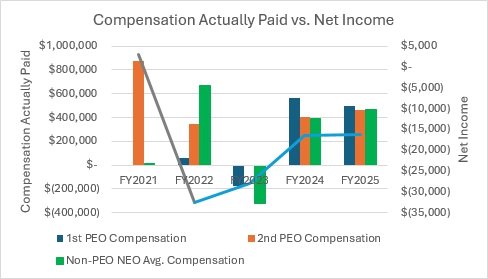
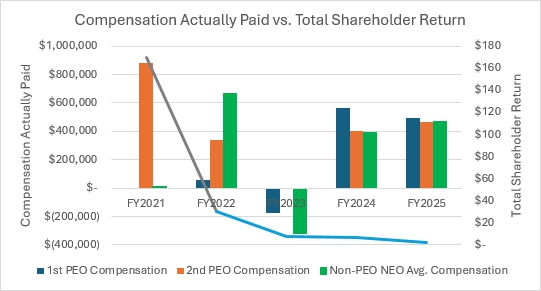
| 33 |
SECURITY OWNERSHIP OF CERTAIN BENEFICIAL OWNERS AND MANAGEMENT
The following table sets forth information regarding the beneficial ownership of our voting securities as of November 9, 2026 by (i) each person known to us to beneficially own five (5%) percent or more of any class of our voting securities; (ii) each of our “Named Executive Officers” (as such term is defined pursuant to Rule 402 of Regulation S-K) and directors; and (iii) all of our directors and executive officers as a group. The percentages of voting securities beneficially owned are reported on the basis of regulations of the SEC governing the determination of beneficial ownership of securities.
Except as indicated in the footnotes to this table, to our knowledge and subject to community property laws where applicable, each beneficial owner named in the table below has sole voting and sole investment power with respect to all shares beneficially owned and each person’s address is c/o XWELL, Inc., 254 West 31st Street, 11th Floor, New York, New York 10001.
The number of shares of Common Stock beneficially owned by the principal stockholders and the percentage of shares outstanding, as set forth below, take into account certain limitations on the conversion of the Preferred Stock or exercise of warrants, as the case may be, to purchase Common Stock.
Beneficial ownership is determined in accordance with the rules of the SEC. For the purpose of calculating the number of shares beneficially owned by a stockholder and the percentage ownership of that stockholder, shares of Common Stock subject to preferred stock, options or warrants that are currently convertible or exercisable, as applicable, or convertible or exercisable, as applicable, within sixty (60) days of November 9, 2026, by that stockholder are deemed outstanding. Under the rules of the SEC, a person is deemed to be a beneficial owner of a security if that person has or shares voting power, which includes the power to vote or to direct the voting of the security, or investment power, which includes the power to dispose of or to direct the disposition of the security.
| 34 |
| Number of | ||||||||||||
| Shares of | ||||||||||||
| Common | ||||||||||||
| Stock | Percentage | Total | ||||||||||
| Beneficially | of | Voting | ||||||||||
| Name and Address of Beneficial Owner(1) | Owned | Class | Power(14) | |||||||||
| 5% or more beneficial owners: | ||||||||||||
| American Ventures LLC Series XXIV XWELL(11) | 993,617 | 9.36 | % | 9.36 | % | |||||||
| Directors and named executive officers: | ||||||||||||
| Ezra T. Ernst(4) | 218,005 | 2.05 | % | 1.89 | % | |||||||
| Bruce T. Bernstein(5) | 1,146,908 | 10.50 | % | 7.91 | % | |||||||
| Gaëlle Wizenberg(6) | 360,617 | 3.36 | % | 2.27 | % | |||||||
| Robert Weinstein(7) | 436,521 | 4.04 | % | 2.50 | % | |||||||
| Michael Lebowitz(8) | 412,861 | 3.83 | % | 2.46 | % | |||||||
| Thomas Ian Brown(9) | 37,000 | * | * | |||||||||
| Gerard Reid(12) | 150,000 | 1.41 | % | 1.41 | % | |||||||
| All directors and executive officers as a group (7 persons)(10) | 2,761,912 | 24.17 | % | 18.44 | % | |||||||
| Suzanne A. Scarbis(13) | -- | * | * | |||||||||
| * | Less than 1% |
| (1) | The information in the table above and in the following footnotes reflects information available to us as of November 9, 2026. A total of 10,620,883 shares of our Common Stock were issued and outstanding as of November 9, 2026. Shares of Common Stock that may be acquired by a person within 60 days of November 9, 2026 pursuant to the exercise of options or other rights are deemed outstanding for purposes of calculating the beneficial ownership percentage of such person, but not for purposes of calculating the beneficial ownership percentage of any other person. |
| (2) | Based solely on information contained in a Schedule 13G filed on August 9, 2024 by XWEL INV I, LLC. XWEL INV I, LLC’s address is 400 Park Avenue, 4th Floor, New York, New York 10022. |
| (3) | Based solely on information contained in a Schedule 13G filed on June 10, 2026 jointly by Iroquois Capital Management, LLC, Richard Abbe and Kimberly Page. The number of shares of Common Stock beneficially owned by Mr. Abbe consists of 354,467 shares held directly by Iroquois Master Fund Ltd. and 79,500 shares held directly by Iroquois Capital Investment Group LLC. Mr. Abbe shares voting and dispositive power over the shares held by Iroquois Master Fund Ltd. and has sole voting and dispositive power over the shares held by Iroquois Capital Investment Group LLC. The address of Mr. Abbe and the other reporting persons is 2 Overhill Road, Scarsdale, New York 10583. |
| (4) | The number of shares of Common Stock beneficially owned includes 201,130 shares of Common Stock and/or vested shares of restricted stock and options to purchase up to 16,875 shares of Common Stock, which are exercisable within 60 days of November 9, 2026. |
| (5) | The number of shares of Common Stock beneficially owned includes 839,882 shares of Common Stock and/or vested shares of restricted stock, including 500,000 fully vested restricted shares granted on August 25, 2026, and options to purchase up to 307,026 shares of Common Stock, which are exercisable within 60 days of November 9, 2026. |
| (6) | The number of shares of Common Stock beneficially owned includes 240,698 shares of Common Stock and/or vested shares of restricted stock, including 50,000 fully vested restricted shares granted on August 25, 2026, and options to purchase up to 119,919 shares of Common Stock, which are exercisable within 60 days of November 9, 2026. |
| (7) | The number of shares of Common Stock beneficially owned includes 265,231 shares of Common Stock and/or vested shares of restricted stock, including 50,000 fully vested restricted shares granted on August 25, 2026, and options to purchase up to 171,290 shares of Common Stock, which are exercisable within 60 days of November 9, 2026. |
| (8) | The number of shares of Common Stock beneficially owned includes 261,122 shares of Common Stock and/or vested shares of restricted stock, including 50,000 fully vested restricted shares granted on August 25, 2026, and options to purchase up to 151,739 shares of Common Stock, which are exercisable within 60 days of November 9, 2026. |
| (9) | The number of shares of Common Stock beneficially owned includes options to purchase up to 37,000 shares of Common Stock, which are exercisable within 60 days of November 9, 2026. |
| (10) | See footnotes (4) through (9) and (12). |
| (11) | On February 24, 2026, the Company entered into a securities purchase agreement with American Ventures LLC Series XXIV XWELL for the issuance and sale in a private placement of an aggregate of (i) 31,333 shares of the Company’s newly-designated Series H Convertible Preferred Stock and (ii) warrants to purchase up to 66,666,669 shares of Common Stock. American Ventures LLC Series XXIV XWELL has also agreed in its Support Agreement to increase its maximum beneficial ownership threshold under its Series H Convertible Preferred Stock to 9.99% and to convert its Series H Preferred into shares of the Company’s Common Stock prior to the Record Date. The number of shares of Common Stock beneficially owned shown in the table is 993,617, representing approximately 9.36% of the 10,620,883 shares of Common Stock outstanding as of November 9, 2026. Eric Newman, as manager of American Ventures LLC Series XXIV XWELL, has voting and dispositive control with respect to the securities being offered. As such, Eric Newman may be deemed to be the beneficial owner (as determined under Section 13(d) of the Exchange Act) of the securities held by American Ventures LLC Series XXIV XWELL. The address of American Ventures LLC Series XXIV XWELL is 3835 PGA Blvd, Suite 103, Palm Beach Gardens, FL 33410. |
| (12) | Mr. Reid was appointed to the Board effective August 3, 2026. The number of shares of Common Stock beneficially owned consists of 150,000 fully vested restricted shares of Common Stock granted on August 25, 2026. |
|
(13) |
Ms. Scarbis is the former Chief Financial Officer of the Company and a named executive officer for the fiscal year ended December 31, 2025. She resigned from the Company effective January 8, 2025. Ms. Scarbis is not included in the current directors and executive officers group. |
| (14) | Total voting power is calculated by dividing the number of outstanding shares of Common Stock over which the holder has voting power as of November 9, 2026 by the 10,620,883 shares of Common Stock outstanding on that date. Unexercised options, warrants and unconverted preferred shares are excluded from this calculation. |
| 35 |
REPORT OF AUDIT COMMITTEE
The Audit Committee, which consists entirely of directors who meet the independence and experience requirements of the Nasdaq Capital Market, has furnished the following report:
The Audit Committee assists the Board in overseeing and monitoring the integrity of our financial reporting process, compliance with legal and regulatory requirements and the quality of internal and external audit processes. This Committee’s role and responsibilities are set forth in our charter adopted by the Board, which is available on our website at www.xwell.com/corporate-governance. This Audit Committee reviews and reassesses our charter annually and recommends any changes to the Board for approval. The Audit Committee is responsible for overseeing our overall financial reporting process, and for the appointment, compensation, retention, and oversight of the work of our independent registered public accounting firm. In fulfilling its responsibilities for the financial statements for fiscal year ended December 31, 2025, the Audit Committee took the following actions:
| ● | Reviewed and discussed the audited financial statements for the fiscal year ended December 31, 2025, with management and CBIZ, our independent registered public accounting firm; |
| ● | Discussed with CBIZ the matters required to be discussed by the applicable requirements of the Public Company Accounting Oversight Board (“PCAOB”) and the SEC; and |
| ● | Received written disclosures and the letter from CBIZ regarding its independence as required by applicable requirements of the PCAOB regarding CBIZ communications with the Audit Committee, and the Audit Committee further discussed with CBIZ their independence. The Audit Committee also considered the status of pending litigation, taxation matters and other areas of oversight relating to the financial reporting and audit process that the committee determined appropriate. |
Based on the Audit Committee’s review of the audited financial statements and discussions with management and CBIZ, the Audit Committee recommended to the Board that the audited financial statements be included in our 2025 Annual Report, for filing with the SEC.
Members of the Audit Committee
Robert Weinstein (Chairman)
Bruce T. Bernstein
Gaëlle Wizenberg
| 36 |
CERTAIN RELATIONSHIPS AND RELATED PERSON TRANSACTIONS
Related Person Transactions Approval Policy
All related party transactions must be approved by our Audit Committee or a majority of our independent directors who do not have an interest in the transaction and who will have access, at our expense, to our independent legal counsel.
Although we do not have a formal policy with regard to approving related party transactions, our Board may consider the following factors when deciding whether to approve a related party transaction: the nature of the related party’s interest in the transaction; the material terms of the transaction, including, but not limited to, the amount and type of the transaction; the importance of the transaction to the related party; whether the transaction would impair the judgment of a director or executive officer to act in our best interests; and any other matters deemed appropriate by our Board.
Transactions with Related Persons
Except as described below, since January 1, 2024, there has not been any transaction, nor is there any currently proposed transaction, or series of similar transactions to which the Company was or is to be a party in which the amount involved exceeds the lower of $120,000 or one percent of the average of our total assets at year-end for the last two completed fiscal years, and in which any director, executive officer, holder of more than 5% of our Common Stock or any member of the immediate family of any of the foregoing persons had or will have a direct or indirect material interest.
On January 30, 2025, the Company entered into a consulting agreement with XWEL INV I, LLC, a greater than 5% beneficial owner of our securities, and its manager, Jason Aintabi, for advisory services. The agreement was extended on May 12, 2025 and amended on December 15, 2025, for aggregate fees of $780,000, and was further extended on January 1, 2026 for three months for an additional $500,000.
On February 24, 2026, the Company entered into an Omnibus Agreement with the January 2025 Investors under which, on March 2, 2026, it repurchased all outstanding senior secured convertible notes, redeemed all outstanding Series G Preferred Stock and redeemed all Series A and Series B Warrants for an aggregate cash price of $9,000,000. The notes are described in our financial statements as held by a related party. Company to confirm whether the January 2025 Investors are related persons under Item 404.
On July 6, 2026, the Company entered into a Securities Purchase Agreement with Express Wellness Group, LLC to sell all of its equity interests in XpresSpa Holdings, LLC and XpresTest, Inc. (the “Sale”), which was approved by our stockholders at a special meeting held on October 28, 2026. On October 5, 2026, in advance of the closing of the Sale and with the Buyer’s consent, XpresTest, Inc. repurchased all outstanding XpresTest restricted stock awards for an aggregate cash payment of approximately $2.7 million, or $9,634.09 per share, including awards held by Bruce T. Bernstein, our Chairman (107 shares, for $1,030,847.61), Ezra T. Ernst, our President and Chief Executive Officer (55 shares, for $529,874.94), and Thomas Ian Brown, our Chief Financial Officer (10 shares, five of which vested in connection with the repurchase, for $96,340.90). The $9,634.09 per share price was based on a valuation of XpresTest of $10.4 million, or 80% of the $13.0 million base purchase price, determined by Company management and Mr. Bernstein in consultation with the Buyer. In addition, Mr. Bernstein received $110,000 in cash in 2025 in respect of his service on the board of directors of XpresTest, Inc.
XpresTest previously entered into commission arrangements with Mr. Bernstein, Mr. Ernst, Mr. Brown and Patti Ward in connection with XpresTest’s pursuit of a government contract with the U.S. Centers for Disease Control and Prevention (the “CDC”) for infectious disease testing services. On July 6, 2026, XpresTest entered into a contract with the CDC with an initial term value of up to $18.1 million. Under the commission arrangements, after the consummation of the Sale, Mr. Bernstein, Mr. Ernst, Mr. Brown and Ms. Ward will be entitled to receive commissions based on the profits, if any, generated by XpresTest under the CDC contract. Each of them has waived the right to receive any commissions for any period during which XpresTest remains under the Company’s ownership prior to the closing of the Sale, and the arrangements will transfer to the Buyer at closing and will not remain an obligation of the Company. Following the closing of the Sale, Mr. Bernstein is expected to provide consulting services to, and Messrs. Ernst and Brown are expected to become employees of, the divested businesses under the Buyer’s ownership. In addition, Mr. Ernst holds 10,000 unvested restricted shares of Common Stock that will vest in full upon a change in control of the Company or a qualifying termination of his employment.
| 37 |
OTHER MATTERS
Stockholders may also consider and act upon such other matters as may properly come before the Annual Meeting. The Board knows of no other business which will be presented at the Annual Meeting and is not aware of any such other matters that may properly come before the Annual Meeting at the present time. If any other matters are properly brought before the Annual Meeting, the persons named in the enclosed Proxy Card or voting instruction form will vote the shares they represent in accordance with their best judgment and in the manner they believe to be in the best interest of the Company to the extent permitted by Rule 14a-4(c) of the Exchange Act.
| 38 |
WHERE YOU CAN FIND MORE INFORMATION
We file annual, quarterly and current reports, proxy statements and other documents with the SEC under the Exchange Act. Company’s SEC filings made electronically through the SEC’s EDGAR system are available to the public at the SEC’s website at http://www.sec.gov. You may also find our SEC filings in the “SEC Filings” section of the “Investors” section of our website at www.xwell.com.
| 39 |
DELIVERY OF DOCUMENTS TO STOCKHOLDERS SHARING AN ADDRESS
If two or more stockholders share an address, we may send a single copy of the 2025 Annual Report, this Proxy Statement, the Notice of Internet Availability of Proxy Materials or other proxy materials, as applicable, to the shared address, unless we have received contrary instructions from one or more of such stockholders sharing the address. Additionally, we will promptly send a separate copy of the 2025 Annual Report, this Proxy Statement, or Notice of Internet Availability of Proxy Materials, as applicable, upon oral or written request by any stockholder at a shared address to which a single copy of the documents was delivered. Such requests should be submitted to XWELL, Inc., 254 West 31st Street, 11th Floor, New York, New York 10001, Attention: Corporate Secretary; telephone number (212) 750-9595. If any stockholders sharing an address receive multiple copies of the 2025 Annual Report, this Proxy Statement, the Notice of Internet Availability of Proxy Materials or other proxy materials, such stockholders may make such request to our Corporate Secretary at the same address or telephone number described above.
| 40 |
STOCKHOLDER COMMUNICATIONS
Stockholders and other interested parties who desire to communicate directly with our independent, non-management directors should submit communications in writing addressed to XWELL, Inc., 254 West 31st Street, 11th Floor, New York, New York 10001, Attention: Corporate Secretary. The Corporate Secretary will, as appropriate, forward communications to the Board or to any individual director, directors, or committee to whom the communication is directed.
| 41 |
SUBMISSION OF STOCKHOLDER PROPOSALS AND DIRECTOR NOMINATIONS AT THE 2027 ANNUAL MEETING
A stockholder who intends to submit a proposal at the 2027 Annual Meeting to be included in the Company’s proxy statement and form of proxy for the 2027 Annual Meeting in accordance with Rule 14a-8 under the Exchange Act must submit the proposal no later than August 5, 2027, in writing to our corporate offices as follows, XWELL, Inc., 254 West 31st Street, 11th Floor, New York, New York 10001, Attention: Corporate Secretary. Such proposal must comply with Rule 14a-8 under the Exchange Act.
In accordance with our Bylaws, a stockholder who intends to submit a proposal at the 2027 Annual Meeting outside of the process of Rule 14a-8 and not to be included in the Company’s proxy statement must follow the submission criteria and deadlines set forth in our Bylaws concerning stockholder proposals, including providing proper notice of the proposal in writing. In addition, a stockholder who intends to nominate a director for election to the Board at the 2027 Annual Meeting must follow the submission criteria and deadlines set forth in our Bylaws concerning stockholder proposals, including providing proper notice of the nomination in writing. Stockholder nominations for director and other proposals that are not to be included in the Company’s proxy statement must be received by our Corporate Secretary in writing at our corporate offices, as listed above, no earlier than October 1, 2027, and no later than October 31, 2027. Any such stockholder proposals or nominations for director must satisfy the requirements set forth in our Bylaws. Stockholders are also advised to review our Bylaws, which contain additional advance notice requirements, including requirements with respect to advance notice of stockholder proposals and director nominations. In addition to satisfying the requirements under our Bylaws, to comply with the universal proxy rules under the Exchange Act, any shareholder who intends to solicit proxies in support of director nominees other than the Company’s nominees must provide written notice that sets forth the information required by Rule 14a-19 under the Exchange Act no later than October 31, 2027.
| 42 |
Form of Reverse Stock Split Amendment
CERTIFICATE OF AMENDMENT TO
AMENDED AND RESTATED
CERTIFICATE OF INCORPORATION OF
XWELL, INC.
Pursuant to Section 242 of the General Corporation Law of the State of Delaware, XWELL, Inc., a corporation organized and existing under the laws of the State of Delaware (the “Corporation”), does hereby certify as follows:
1. The name of the Corporation is XWELL, Inc. The date of filing of its original Certificate of Incorporation with the Secretary of State of the State of Delaware was January 9, 2006, under the name of Vringo, Inc. The name of the Corporation was changed to FORM Holdings Corp. by filing a Certificate of Amendment to the Certificate of Incorporation with the Secretary of State of the State of Delaware on May 5, 2016. The name of the Corporation was changed to XpresSpa Group, Inc. by filing a Certificate of Amendment to the Certificate of Incorporation with the Secretary of State of the State of Delaware on January 5, 2018. The name of the Corporation was changed to XWELL, Inc. by filing an Amended and Restated Certificate of Incorporation with the Secretary of State of the State of Delaware on October 24, 2022.
2. The Board of Directors of the Corporation has duly adopted a resolution pursuant to Section 242 of the General Corporation Law of the State of Delaware setting forth a proposed amendment to the Amended and Restated Certificate of Incorporation of the Corporation and declaring said amendment to be advisable. The requisite stockholders of the Corporation have duly approved said proposed amendment in accordance with Section 242 of the General Corporation Law of the State of Delaware. The amendment amends the Amended and Restated Certificate of Incorporation of the Corporation as follows:
3. Article IV of the Corporation’s Amended and Restated Certificate of Incorporation is hereby amended and restated in its entirety:
“4. Upon the effectiveness of the filing of this Certificate of Amendment (the “Effective Time”) each share of the Corporation’s common stock, $0.01 par value per share (the “Old Common Stock”), either issued or outstanding or held by the Corporation as treasury stock, immediately prior to the Effective Time, will be automatically reclassified and combined (without any further act) into a smaller number of shares such that each [●] shares of Old Common Stock issued and outstanding or held by the Company as treasury stock immediately prior to the Effective Time is reclassified into one share of Common Stock, $0.01 par value per share, of the Corporation (the “New Common Stock”), the exact ratio within such range to be determined by the board of directors of the Corporation prior to the Effective Time and publicly announced by the Corporation (the “Reverse Stock Split”). The Board of Directors shall make provision for the issuance of that number of fractions of New Common Stock such that any fractional share of a holder otherwise resulting from the Reverse Stock Split shall be rounded up to the next whole number of shares of New Common Stock. Any stock certificate that, immediately prior to the Effective Time, represented shares of the Old Common Stock will, from and after the Effective Time, automatically and without the necessity of presenting the same for exchange, represent the number of shares of the New Common Stock into which such shares of Old Common Stock shall have been reclassified plus the fraction, if any, of a share of New Common Stock issued as aforesaid.
4. Notwithstanding the immediately preceding sentence, no fractional shares shall be issued as a result of the reverse stock split. Instead, any stockholder who would otherwise be entitled to a fractional share of Common Stock as a result of the reclassification shall be entitled to receive a cash payment equal to the product of such resulting fractional interest in one share of Common Stock multiplied by the closing trading price of Common Stock on the Nasdaq Capital Market on the trading day immediately following the Effective Time. Notwithstanding the foregoing, the Corporation shall not be obliged to issue certificates evidencing the shares of Common Stock outstanding as a result of the reverse stock split or cash in lieu of fractional shares, if any, unless and until the certificates evidencing the shares held by a holder prior to the reverse stock split are either delivered to the Corporation or its transfer agent, or the holder notifies the Corporation or its transfer agent that such certificates have been lost, stolen or destroyed and executes an agreement satisfactory to the Corporation to indemnify the Corporation from any loss incurred by it in connection with such certificates.
| C-1 |
5. Each stock certificate that, immediately prior to the Effective Time, represented shares of Common Stock that were issued and outstanding immediately prior to the Effective Time shall, from and after the Effective Time, automatically and without the necessity of presenting the same for exchange, represent that the number of whole shares of Common Stock after the Effective Time into which the shares of Common Stock formerly represented by such certificate shall have been reclassified (as well as the right to receive a cash payment in lieu of a fractional share of Common Stock), provided, however, that each person of record holding a certificate that represented shares of Common Stock that were issued and outstanding immediately prior to the Effective Time shall receive, upon surrender of such certificate, a new certificate evidencing and representing the number of whole shares of Common Stock after the Effective Time into which the shares of Common Stock formerly represented by such certificate shall have been reclassified (including the right to receive a cash payment in lieu of a fractional share of Common Stock).”
This Certificate of Amendment shall be effective on [●] at [●] Eastern Time.
IN WITNESS WHEREOF, the Corporation has caused this Certificate of Amendment to be signed by its Chief Executive Officer on this [●] day of [●], [●].
| By: | ||
| Name: | Ezra T. Ernst | |
| Title: | Chief Executive Officer |
| C-2 |
| Signature [PLEASE SIGN WITHIN BOX] Date Signature (Joint Owners) Date TO VOTE, MARK BLOCKS BELOW IN BLUE OR BLACK INK AS FOLLOWS: KEEP THIS PORTION FOR YOUR RECORDS DETACH AND RETURN THIS PORTION ONLY THIS PROXY CARD IS VALID ONLY WHEN SIGNED AND DATED. T05350-P60066 2. To ratify the selection of CBIZ CPAs P.C. as the Company's independent registered public accounting firm for the fiscal year ending December 31, 2026 (the "Auditor Ratification Proposal"). 3. To approve an amendment (the “Reverse Stock Split Amendment”), substantially in the form attached hereto as Annex A, to the Company's Certificate of Incorporation to effect, at the discretion of the Board but prior to the one-year anniversary of the reverse stock split (the “Reverse Stock Split”) approval by the Company's stockholders at the Annual Meeting, the Reverse Stock Split at a ratio in the range of 1-for-2 to 1-for-25, with such ratio to be determined by the Board in its discretion and as disclosed in a public announcement (the “Reverse Stock Split Proposal”). 4. To approve the adjournment of the Annual Meeting to a later date or dates, if necessary or appropriate, to permit further solicitation and vote of proxies in the event that there are insufficient votes for, or otherwise in connection with, the approval of any one or more of the foregoing proposals (the "Adjournment Proposal"). For Against Abstain XWELL, INC. The Board of Directors recommends you vote FOR the following proposals: XWELL, INC. 254 WEST 31ST STREET 11TH FLOOR NEW YORK, NY 10001 Please sign exactly as your name(s) appear(s) hereon. When signing as attorney, executor, administrator, or other fiduciary, please give full title as such. Joint owners should each sign personally. All holders must sign. If a corporation or partnership, please sign in full corporate or partnership name by authorized officer. 01) Bruce T. Bernstein 02) Robert Weinstein 03) Gaëlle Wizenberg 04) Michael Lebowitz 05) Gerard Reid Nominees: 1. To elect the five directors to the Board of Directors (the "Board"), each to serve until the 2027 annual meeting of stockholders or until his or her respective successor is duly elected and qualified (the "Director Election Proposal"). The Board of Directors recommends you vote FOR the following: ! ! ! To withhold authority to vote for any individual nominee(s), mark "For All Except" and write the number(s) of the nominee(s) on the line below. For All Withhold All For All Except ! ! ! ! ! ! ! ! ! VOTE BY INTERNET Before The Meeting - Go to www.proxyvote.com or scan the QR Barcode above Use the Internet to transmit your voting instructions and for electronic delivery of information up until 11:59 p.m. Eastern Time the day before the cut-off date or meeting date. Have your proxy card in hand when you access the website and follow the instructions to obtain your records and to create an electronic voting instruction form. During The Meeting - Go to www.virtualshareholdermeeting.com/XWEL2026 You may attend the meeting via the Internet and vote during the meeting. Have the information that is printed in the box marked by the arrow available and follow the instructions. VOTE BY PHONE - 1-800-690-6903 Use any touch-tone telephone to transmit your voting instructions up until 11:59 p.m. Eastern Time the day before the cut-off date or meeting date. Have your proxy card in hand when you call and then follow the instructions. VOTE BY MAIL Mark, sign and date your proxy card and return it in the postage-paid envelope we have provided or return it to Vote Processing, c/o Broadridge, 51 Mercedes Way, Edgewood, NY 11717. SCAN TO VIEW MATERIALS & VOTEw |
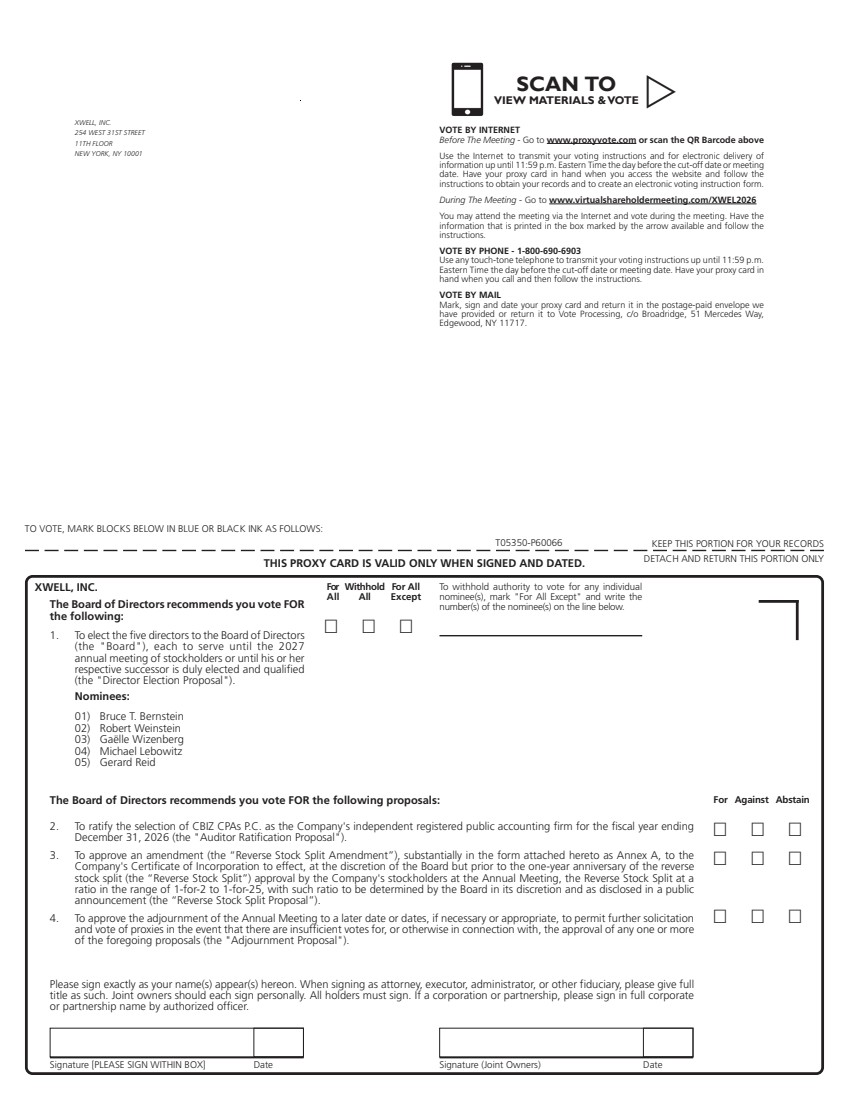
| Important Notice Regarding the Availability of Proxy Materials for the Annual Meeting: The Notice and Proxy Statement and Form 10-K are available at www.proxyvote.com. T05351-P60066 XWELL, INC. ANNUAL MEETING OF STOCKHOLDERS DECEMBER 30, 2026, 10:00 A.M. ET THIS PROXY IS SOLICITED ON BEHALF OF THE BOARD OF DIRECTORS The stockholder(s) hereby appoint(s) Bruce T. Bernstein, as proxy, with the power to appoint his substitute, and hereby authorize(s) him to represent and to vote, as designated on the reverse side of this ballot, all of the shares of Common Stock of XWELL, INC. that the stockholder(s) is/are entitled to vote at the Annual Meeting of Stockholders to be held at 10:00 a.m. ET, on December 30, 2026, at www.virtualshareholdermeeting.com/XWEL2026, and any adjournment or postponement thereof. This proxy, when properly executed, will be voted in the manner directed herein. If no such direction is made, this proxy will be voted in accordance with the Board of Directors' recommendations. Continued and to be signed on the reverse side |